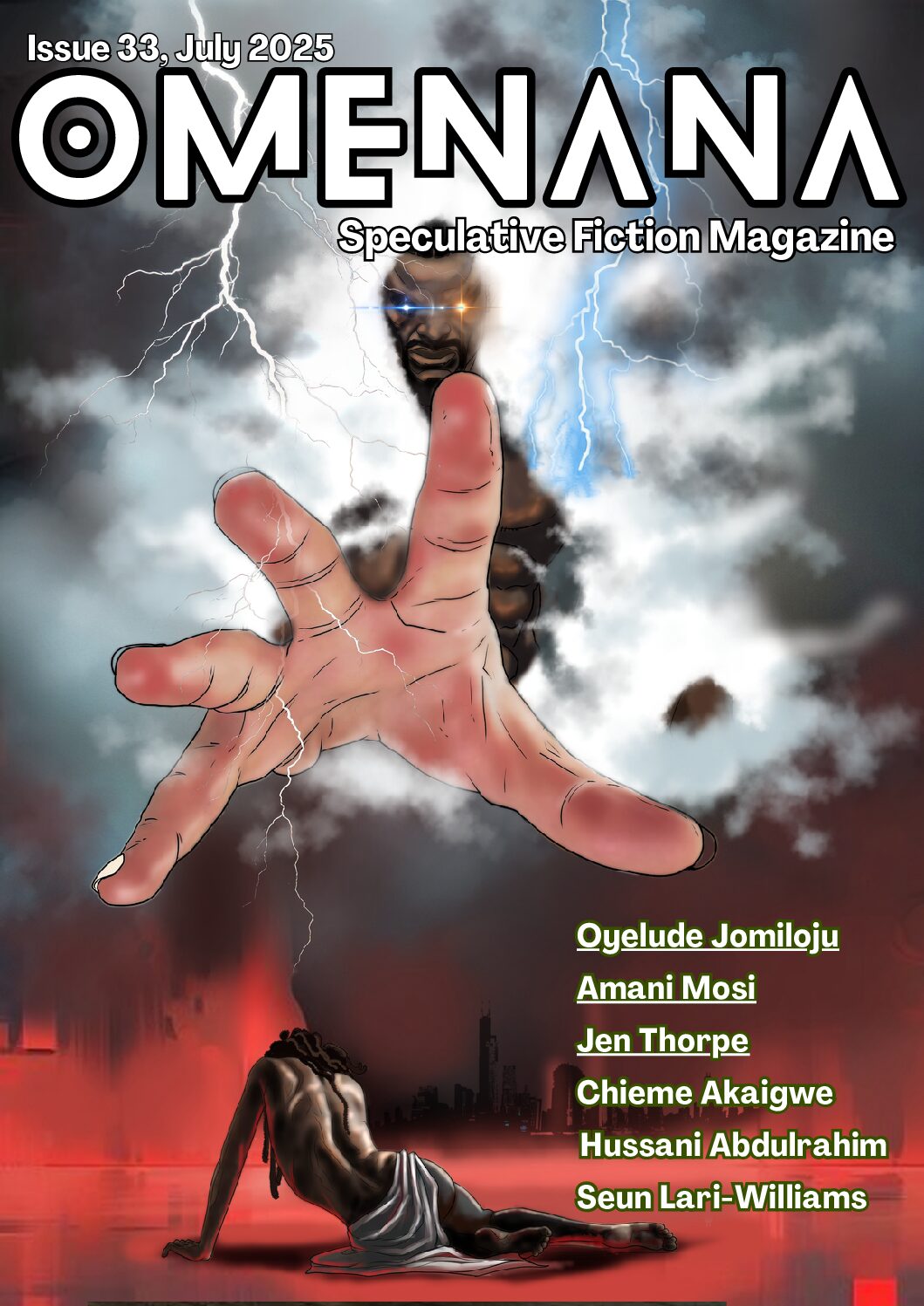
That we dance between worlds to taste sorrow again and again.
That we are nothing but wind in the womb, fire in the cradle.
But not this time.
This time, I came to stay—at least until she learned. Until she saw through the man who called himself a master of doors but can’t even find the keyhole, much less turn the lock.
I had left her five times before, in seasons she named after hope: Joko, Bamidele, Durotimi, Bamitale. I watched each name wither on her tongue. But the sixth time, I paused. Because I had seen her future—and it was worse than all my deaths.
It was him. That bastard with his charcoal eyes and ash-dusted feet. Her juju man.
Oh, he was a spectacle, that one. A peacock strutting in borrowed plumes. They came from miles around, their faces etched with worry and hope in equal measure, to sit at the dusty hem of his embroidered robes. Women clutching wilting herbs and meagre coins, their voices hushed with pleas for barren wombs to quicken or wayward husbands to return. Men with furrowed brows seeking blessings for their harvests or protection from unseen enemies. Children, their eyes wide with a mixture of fear and fascination, clinging to their mothers’ wrappers.
His compound buzzed like a disturbed hive. Goats were tied to crooked fences, their bleating a constant undertone to the murmur of supplications. Clay pots bubbled with concoctions whose pungent smells drifted through the hot air. Cowrie shells, polished smooth by countless fumbling fingers, lay scattered on woven mats, waiting to be “read” by his knowing gaze.
He held court under the shade of a sprawling mango tree, his voice banging with pronouncements that mixed ancient (twisted) wisdom with blatant fabrication. He’d wave a gnarled stick, its tip adorned with feathers that looked suspiciously like they’d come from a common bush fowl. He’d chant incantations in a language that sounded vaguely familiar yet was ultimately meaningless gibberish. And the people? They swallowed it up like akpu. They nodded like lizards, they gasped, they wept.
His reputation had grown like a stubborn weed. Success stories—a baby born after years of trying, a lost trinket miraculously found—were whispered and embellished as they traveled from village to village. Failures were attributed to the stubbornness of spirits or the lack of faith in the supplicant. He was a master of deflection, a weaver of convincing narratives that always landed him on solid ground, and lined his pockets with the desperate offerings of the hopeful and the fearful.
My mother was just one of many in that endless queue, her face a mask of yearning as she waited her turn, clutching her lean gifts. And I, a silent observer just behind her, seethed. How could they not see? How could they be so easily swayed by this charlatan’s theatrics? But then I remembered my own past departures, the raw grief in her eyes, and understood the depth of her need to believe, even in the face of blatant falsehood.
He said I was stubborn. A spirit that refused to obey. He declared me a wild one while fumbling with cowries he didn’t know how to read. He called on tongues he didn’t speak. And still, she believed him.
My mother, oh, my mother—she looked at him the way dry earth looks at clouds after famine has squeezed it hard. She brought him yam, soap, cloth, coins wrapped in old scarves. Each time he asked for more, she gave. When he told her to bury a turtle’s egg beside my mat, she did it in tears, whispering, begging, “Stay. Please stay.”
And I did. That time, I stayed…until the drum call.
She wrapped my ankles in thread and chalk. She fed me bitter herbs until my tongue forgot sweetness. Each morning, she pressed her ear to my chest as if listening for a sign—for proof that I hadn’t slipped away.
My father had been a practical man—his yam mounds stood in perfect rows, his prayers brief as a harvest knife. He died before I drew my first breath, leaving her with nothing but the kind of grief that hollows out a woman’s bones. So no, I could not let this ash-footed fraud peel the last flesh from her spirit. Not when she had already buried half herself in my father’s grave.
The rubbish man now came to our house every week with a new chant and a higher price. I watched him grow younger, fattened by her hope.
One day, I tested him, hoping my mother would notice something.
I etched symbols in the sand outside our hut—ones only spirit-folk know. He stepped on them without pause.
Another time, I feigned illness and whispered a question in the tongue of the in-between. A true juju man, a Babaláwo would’ve known what I asked. He only blinked and said I must have eaten something spoiled.
I stayed to save her from him. To teach her to save herself from these evil men.
Years passed. My legs grew strong. I laughed. I teased. I loved. My mother aged gently, like someone wearing a shawl she’d chosen. She began to tell me stories—not of charms or spirits—but of stubborn yam seedlings, the stars, and how rivers carry memory. She started to laugh too.
Still, the man came. I loathed him. I wanted to shout that he knew nothing. That I knew his words before he spoke them. That I could undo his chants in my sleep.
I tested him some more, so she could see him for he was.
Nothing.
And then, one day, I noticed something.
It wasn’t sudden. It was just a softening around her eyes when he spoke. A sigh too quiet to name. A glance she’d toss me, wry and warm, while he rambled on about binding spirits. That was when I began to wonder: had she known all along, or did she just come to realise it?
I mimicked a spirit elder’s lament I’d once overheard in the spaces-between. I spoke of a forgotten wellspring. She paused while stirring the evening stew. Her hand froze. Her eyes clouded. Then, she simply sang a song she’d sung many times: “I, too, have left footprints in the dust of other worlds”, the meaning of the words dawning on me for the first time.
Another time, when our man called a rare blue feather I’d found a powerful charm. My mother plucked it from my hair and said, “A pretty thing, but your laughter is the best shield.”
Yet, understanding came slowly to me. Like dawn that one doesn’t notice until the sky has already turned.
She wasn’t fooled. She had always known he was a fraud. Maybe she carried a whisper of the other world in her too—a thin echo that helped her see through him. That’d have been rare, but it wasn’t unheard of.
I still wasn’t sure.
But if she knew… then why?
Why the offerings? The prayers whispered into empty air? Why let the charade enrich the very man I’d stayed to guard her from?
When she lay dying, my old woman, I sat beside her.
Her hand, still strong despite time, cupped my cheek. “My stubborn fire, my wind-borne joy,” she murmured. “It was never about him. I knew you loved me. I knew this time it was different. But as long as I needed him… you stayed. He was never a priest, just the rope I tied you to earth with.”
After she died, I waited to be pulled—back to the between. But no hand came.
No drumbeat called me home.
Only silence.
And an understanding that she’d since broken the drum.
Seun Lari-Williams is a Nigerian writer and poet currently based in Antwerp, pursuing a PhD. He is the author of the poetry collections “Garri for Breakfast” (2016) and “A Little Violence” (2022), with his debut collection being longlisted for the NLNG Nigeria Prize for Literature.
The earth is bare, gaping like a mouth waiting to be fed sorrow. The family stands around it, their eyes fixed on me, not with pity, but with a quiet, foolish expectation. Because I am a woman. The chosen one. The one who must reach down into the past and open it.
My back aches. Sweat slides down the curve of my spine. My sons are with Iya Onitedi’s first daughter; far enough to be safe but close enough to be scarred.
They want me to do this. All of them. I see it on their faces. Some carry anger. Others wear something like guilt. But none of them step forward. They just wait.
The shovel scrapes against the wood. I pause, whisper a prayer into the silence, mostly for myself. My hands tremble as I lift my nose mask, bracing for a wave of rot, a swarm of flies, and the kind of smell that sticks to your memory like oil.
But none comes.
I open the casket.
And there she is.
Abeni.
Laid out as if she’d only just gone to sleep. The gold lace is still smooth on her body. No fluids. No decay. Her skin is intact. Her dress, unstained. And her face, calm.
Two years buried, yet she looks exactly as they said she did the morning they found her: dressed, painted, quiet.
I scream.
And the men rush toward me.
*
Baba Mabeweje died last week. And his death ushered in an era of chaos into my life.
I’ve come to realize that a young wife shouldn’t ask a husband his age. Such questions could breed annoyance in the man, and in me, it would stir something worse. A crawling revulsion whenever his weight pressed over me at night. So, I never asked. I never wanted to know.
Then, his people showed up. Baba Sadiyat, Iya Onitedi, and Brother Amoo. They sat in the parlour on the old, sagging sofa like mourners at the grave of a young man. But I had seen the white of Baba’s hair. I had seen the steady wilt of him. He was older than my father, who had traded me for one hundred thousand naira. But that was not what kept me awake. Not the trade. Not the age.
It was the way Baba died. There was something uncanny about it. Something strangely familiar about how I found his body that day.
“Araoluwa,” Baba Sadiyat called, his head gently shaking, his cap lopsided from haste. “It is well. God will comfort you and your children. He will keep you long, long.”
Foolish man. Baba never liked him—said he was always begging.
Iya Onitedi sat beside me, my twin boys curled into her arms. They were just six years old. She stroked their heads like she was smoothing out grief. “God will help you raise these boys. This is your house now. Baba left it for you. You gave him sons.”
That was what I meant to them. A mother of sons. The key to a legacy. Baba had other women. But he had only married two of us. The first, Abeni, gave him only pain. Every child she had carried slipped away. He believed he was cursed. Until me.
Brother Amoo started to talk, the only one among them who ever felt like a human. “Let the man rot in peace,” he said. “This is not why we are here. Araoluwa is the one in mourning. Tell her the rest.”
Iya Onitedi sighed and whispered some Yoruba words to my sons, sending them to the room they share, right next to the one where their father died, fully dressed in buba and shoes, lying on the bed as if waiting to be called somewhere. But it was night. He had nowhere to go.
Baba Sadiyat turned to me. “There is a thing we do in our family. Husbands and wives must be buried together. Do you know what that means?”
I shook my head. “I’m not going with him.”
Brother Amoo chuckled, soft and bitter. “Not you. They mean Abeni.”
At once, the air stilled. My chest tightened. My heart thundered. Abeni, Baba’s first wife. She had been only three years older than me. They found her two years ago, sniper bottle on the bed, dressed head to toe in iro and buba, her face powdered, and her lips painted. Just like Baba.
I knew where this was going. And I dreaded it.
“You, Araoluwa,” Iya Onitedi said, eyes calm and voice low, “will go and dig her up. We will bury her with Baba.”
Brother Amoo nodded. “In our family, when a man and woman are bound by marriage, they must be buried together, side by side, even if they die years apart. The one who dies first is buried alone. When the second dies, their grave must be reopened so they can rest together at last.
“Only a woman can open the first grave, whether a daughter, niece or a sister or, in your case, a surviving wife. If you were not here, a woman in our family would have been the one to join Baba and Abeni together.”
“Men aren’t allowed,” Iya Onitedi added as if she read my mind. “The dead won’t answer them. It’s said that if they aren’t joined properly, neither spirit will rest. And the living will carry the curse of their unrest.”
“And besides, Baba would have wanted you to do it,” Baba Sadiyat said.
I knew no matter how much I resisted; it wouldn’t change anything. Baba had told me before that it was mandatory, and he had always wished to be buried with me instead. It had been a foolish rule of the family. One I never understood. Who wanted to spend eternity beside a man older than her father? What kind of peace was that? That wasn’t resting. That was punishment.
Abeni never liked me. Not when she was alive. She said her miscarriages worsened when I came into the house. That her babies vanished from her faster than stones from a child’s pocket.
She was heavy, always sweating, eyes rimmed red like she’d been crying even in her sleep.
But Baba didn’t love her. You could see and hear it. He spoke to her like a dirty rag. Called her names. Dismissed her.
But she was not a quiet wife. She bit back. Hissed, barked, threw her words like pebbles. And still, they clung to each other like enemies locked in a long, tiring battle. Their bodies met like weapons, fierce and fast. She wanted a child the way a child wants its mother: desperately, blindly. She wanted proof she still mattered.
And then they wanted me to dig her up, to tie her to the man who had wounded her every day of her life.
No. Let the earth keep her where she was. Let her bones lie free, far from him.
I would not be the one to unbury her sorrow.
Heaven forbid. I’d rather die.
*
Brother Amoo arrived the next morning. I was sitting with my sons, stirring pap, the steam curling between us like matters that did not need to be discussed. He didn’t knock. Just walked in like he had rights over my peace.
“You have to do it,” he said, standing in the doorway as though the words were heavier than he could carry.
I didn’t look up. “I won’t.”
“You know it’s not a choice.”
“I’m a woman,” I said, still stirring. “Not a shovel. I won’t dig up the dead for the sake of some tired ritual. Baba wanted that? Then Baba was mad.”
He stepped closer. “If you don’t, nothing will come to you. The land, the house, it all stays out of your hands. He must be laid to rest properly, or he’s not truly gone. That’s the belief. My father and mother were buried the same way. My sister opened up my father’s grave so my mother could be buried with him.”
“And why can’t another woman in your family do it?” I asked, slowly and quiet. Baba’s side of the family had always been loud, but not like this. Not cruel.
He paused, turned to leave, then stopped at the door. “Because you are Baba’s surviving wife. What sense would it make to use another woman when you are here,” he asked. “You don’t even have a choice. And if you don’t agree, and someone else in the family does it, then you and your children should be ready for what comes.”
He stepped out, the wooden door closing behind him like a final word.
I watched him go, bitterness rising in my throat. Then I cursed him like a prayer meant to bruise.
That night, I dreamt of Abeni again.
She stood at the foot of my bed with her arms folded, watching. Not angry. Just there. Her lips were cracked, her eyes carrying a soft, tired kind of sorrow.
I’d seen her in dreams before. Once she danced in silence under the moon, her bubu gown flowing. In another dream, she was cooking in a pot that contained nothing.
Another time, she laughed, and the sound stayed with me for days.
Before she passed, there had been a night when I found her in the boys’ room.
She didn’t startle. Just looked at me dry-eyed.
I kept my voice gentle, though my heart was beating hard in my chest. “Did you come to see our sons, iya ile mi?”
“They are yours,” she said, turning away. “Not mine.”
Later, I found the boys asleep, curled toward each other. Between them, two small, wrapped gifts in a blue plastic bag. Then I remembered, the next day was their birthday.
*
The day after we open the grave, they gather again. This time, they do not say a word. They wait. We are seated again in the doomed sitting room. The air is heavy with sweat and silence. Iya Onitedi fans me with a folded newspaper, her movements are brisk, but her eyes avoid mine.
I am shaking. My legs quiver, though they do not move. Everyone is watching me, waiting, like I am stitched skin they’re afraid will burst open.
“Araoluwa, breathe,” says Baba Sadiyat, calm, too calm. “Today you’ll understand why most of us never liked Abeni.”
“She wasn’t decayed.” My voice slices through the room, hard and trembling. The fury behind it surprises even me.
Iya Onitedi lowers the fan. “You will not speak to us like that.” She straightens her back, insulted. “Yes, she wasn’t decayed. Because Abeni wasn’t ordinary. She was touched. You knew it. That’s why she died like that. Who wears beads and lipstick to go to her grave?”
“She wasn’t decayed,” I repeat, softer now, not out of calm but out of something deeper. Dread. Shock. The words feel like stones in my mouth. “She looked like she had just… fallen asleep.”
No one flinches.
“Araoluwa,” Baba Sadiyat says, “Baba buried her with a charm. It stops decay. He was afraid her spirit would rise against him if she rotted. Her grandmother died the same way and took her husband with her. Abeni never forgave him for marrying you. She never did.”
I stare at them. My mouth is open, but no words come.
“You made me open her casket,” I whisper, voice shaking. “You made me open a cursed grave, knowing she wasn’t rotting. You didn’t tell me about the charm. Or that she might still be alive. You set me up.”
“No, we didn’t know her body would still be like that,” Iya Onitedi says firmly. “We were just doing what’s right.”
I look at them all. Their faces are calm, almost blank, as if this is just another afternoon, another tale over bitter kola and gossip.
“Is Abeni truly dead?” I ask the real question. The one that won’t leave me alone.
“Yes,” Iya Onitedi says. “And Baba will be buried beside her. Then, maybe, her jealous spirit will rest.”
“Are you sure?” I ask again, my voice barely a breath.
“We are very sure,” Baba Sadiyat replies, his voice like a stone closing a grave.
*
Baba and Abeni are buried now. Side by side, as they once were in life. There’s a quiet finality to it. I feel no sorrow. Only a strange kind of lightness. At last, I can breathe my own breath. Think my own thoughts. Dream of a life that belongs to me and my children.
I sit in my room, sorting through the crumpled naira notes I earned last week from the fish stall. My fingers are slick with the faint scent of smoked tilapia, and the sound of the street buzzes faintly through the window slats.
Kola bursts in, his face stretched wide with excitement. “Mummy! Kayode is with Big Mummy. She says she wants to see you.”
I pause. “Big Mummy?” The name clings to the air in the room like incense smoke.
There’s only one person they ever called that.
I rush outside, my heart suddenly unsure of its rhythm. And there she is.
Abeni.
Standing in the same gold lace and heavy rouge they buried her in. Her lipstick is too red. Her eyes, too alive.
She smiles.
“Araoluwa, the brave one. You think I’m gone?”
And then she laughs. “I am back for our sons.”
My mouth opens but no words come. I raise a hand to push the boys behind me, but my knees give. The gold of her lace glints once more and the world folds into black.
THE END
Jomiloju Oyelude is a writer, a microbiologist and an editor at Akowdee Magazine. Ever fascinated by fantastical and mystical stories, she is an avid reader of the speculative genre. Her short work of fiction has appeared in Brittle Paper. Connect with her on X @creativejjay.
Kalonje was the best of villages. It was the oldest of villages. There was something strange about Kalonje. The village was caught in a spell that slowed even the wind until it moved like honey under water. Footsteps sounded like echoes of themselves. Dust was its own language. It got into everything — coated the tongue, gritted between the teeth and filmed the eyes. The elder’s half-closed eyes swore it was the dust of creation itself, sifted down through epochs.
Simweko arrived as the sun bled its last onto the hills. The bus coughed him out near a crooked mango tree that bowed like an old woman listening to the dead. The conductor didn’t wait to see if he had his bags. He didn’t even look back at him. Nobody ever did. No one welcomed Simweko. Not even the wind. He cinched the satchel tighter — the bag straps memorizing the curve of his shoulder — and marched into the village. He passed women with eyes like drained wells, pounding cassava into ash. Walked past a barefoot boy who gazed at him as though he was the ghost — you shouldn’t be here —the boy’s eyes proclaimed.
The wind dragged a chicken feather across his path. At the edge of the village, an old man sat cross-legged under a fig tree. His skin looked older than a tree’s bark. He was blind. Not because of cataracts or missing pupils, but because his eyes had simply given up.
“You’re the one from the city,” the old man said.
Simweko’s legs could no longer bear the village’s sand.
“How did you?”
“The dust told me. She always gossips when strangers come,” he grinned and revealed teeth which were like pale stones. Some missing. “I am Mutale. Griot. Keeper of things people throw away.”
Simweko’s hand rose. Not quite to his chin, but hovering near the hollow of his throat. His eyes dropped to the floor, then climbed back to meet Mutale’s. Were his eyes searching? Pleading? Or perhaps seeking a place to rest that wasn’t so heavy with knowing? A slow breath slipped past his lips. He had brought a notebook, a recorder, questions approved by the university that never once sent someone into Kalonje. But as he looked at Mutale, the questions felt useless. Too imprudent.
Nightfall trailed the sun’s retreat. Simweko sat still beneath a roof stained with old leaks; besides a plate of nshima and chicken that had long gone cold. He hadn’t touched it. Some silences are not meant to be filled.
Mutale’s voice was low and worn, like a drum that had been played too long.
“There was once a time when Africa healed herself,” he said. “But someone stole the cure and buried it in your sleep.”
Simweko’s pen remained cold in his hand; as an old oil lamp sputtered in the twilight. The next morning, the sky wore a restless grey like it hadn’t quite made up its mind. Simweko found Mutale seated on the same mat beneath the fig tree, tapping his fingers on a calabash drum that had no skin.
“You said something strange last night,” Simweko began, unsure of whether to sit or stand. “That Africa healed herself. Then someone stole the cure.”
Mutale chuckled. “Strange to you. Memory to me.”
“Are you saying it happened?”
“I’m saying I was there. And so were you, though you’ve forgotten.”
He clenched his lips, and the skin between his eyebrows wrinkled like a gathering storm. He took out his notebook and said, “I’m here to record oral histories. Legends. And folktales.”
“What if I’m not telling stories?” Mutale’s voice was even. “What if I’m trying to remember the parts you lost?”
Simweko gazed at the ground. His fingers were absentmindedly tracing the rim of his cup. The recorder in his pocket felt like a confession. By midday, whispers had started curling through the village like smoke. Mutale had spoken again. To a woman at the well. To a teacher whose brother had vanished last year. To an old man who kept a chicken but no family.
He told the teacher his brother hadn’t drowned, as they believed. “He was taken,” Mutale said, “by men in a green Toyota before sunrise. The tyre tracks were swept with a broom made of maize stalks.”
The next day, someone from the city came and confirmed it — a green Toyota Hilux was spotted by the riverbank on the morning of the brother’s disappearance.
The woman at the well? Mutale believed her husband had buried money in the field before dying. She dug into the fading light of evening and found it in a rusted metal box wrapped in a newspaper from 1996.
By the third story, the village had stopped calling Mutale a madman. But they didn’t call him a prophet either. They called him weird. Uncomfortable.Unnatural. Simweko noticed it all — the sudden silence, the way heads dropped and eyes averted as people neared the fig tree. And how they started locking doors again, even though crime in Kalonje was a thing for Lusaka headlines.
The same night, as he sat outside his hut, Simweko looked at the recorder he’d placed beside Mutale during their afternoon conversation.
He rewound it. Clicked play.
Mutale’s voice crackled:
“You think I see the future. But no, young man. I am only remembering the parts that were erased. Africa is a palimpsest, and I still see the first story beneath the scratches.”
Then silence. Followed by something faint in the background.
It rained that night. A stubborn, whispering rain that tapped on the roofs like a mother trying to wake a sleeping child. Simweko had a dream. He dreamt of fire. Of cities burning and children singing songs inside collapsed classrooms. He woke up before dawn. Mutale was already waiting under the fig tree. The villagers no longer greeted him. Even the schoolchildren had stopped mimicking his gait.
“You heard it too,” the old man said before Simweko could speak. “The fire. It’s the second forgetting. It comes soon.”
Simweko sank onto his haunches beside Mutale. His knuckles gripped his knees as tendons stood out like taut wires. A tremor ran through his calf and begged to push him upright, to flee. But his ears strained.
“Tell me,” he said.
Mutale’s head tilted like a sundial’s shadow. His gaze slipped past the dusty yard. Not emptiness in his eyes. But a focus turned inward. Or beyond.
“There is a drum buried under the soil of this village. Not a real drum,” he added, tapping his chest. “A memory. Once, it beat so loud the entire continent danced in rhythm. Crops didn’t fail. Children grew full of purpose. Kings ruled wisely. But the beat grew too strong.”
He froze mid-breath. Not stillness. But collapse arrested; as his spine curved like a bowstring released. “So, they silenced it,” he continued. “Buried the drum and taught us to dance off-beat. That’s what the West never understood. We didn’t lose our rhythm. It was stolen. Now, only echoes remain.”
Simweko bat an eyelid. His smile painted the fig tree with chalk. And called it progress. Mutale wore trousers to the drumbeat. And smiled backwards like cursed goats. Was this beauty? Or was this the madness of the lost?
“You said they silenced it. Who is ‘they’?”
A twitch crept upon Mutale’s lips and drew them into a smile. It didn’t reach his cheeks, let alone his eyes. It was the smile a man wears before a wrestling match begins. But Simweko preferred when he frowned; at least then he was honest.
“There is a man in Lusaka. His name is Mr Njovu. He works for something older. His grandfather was one of the Erasers — men trained to rewrite oral memory.”
Njovu was one of the interviewees Simweko was meant to meet next month.
“He’s the one looking for me,” Mutale added. “He knows I remember what they wiped.”
“This… this is conspiracy talk.”
“Is it?” Mutale asked. “Then ask yourself, why did your university approve this research, fund this trip but never brief you properly on what to look for? Why Kalonje? Why me?”
“I don’t know.”
“Wise answer,” Mutale mused.
Simweko saw that Mutale wasn’t lying. Of course not. It was the way he leaned back, calm as a chief after confiscating someone’s land. The way Mutale spoke left Simweko strangely sure. But it wasn’t relief he felt. It was the cold realization that truth never came without chains. And no one had told him which wrist to offer first. The lion does not lie about blood. But whose spear must strike next? Whose name must the wind carry?
Three days had passed in restless quiet. The villagers no longer spoke to Simweko. Even Mama Chanda; who once brought him boiled groundnuts. Rumours moved like ants. The griot was cursed. The boy from the city was his vessel. And Kalonje would soon be swallowed by something they couldn’t name.
On the fourth morning, a black tinted Prado 4×4 rumbled into the village. It parked beside Chitembele Primary School without a word. Two men stepped out with dark suits and clean shoes. One of them flashed a badge — CILG. They didn’t speak to anyone. Why would they? They went straight for the fig tree. They assumed Mutale would be there. But he wasn’t.
Simweko found him an hour later, deep in the thicket behind the village.
“I heard the tyres,” Mutale said. “They came with the wrong names in their mouths.”
He was digging. Not with tools. But with memory.
Beneath the roots of a musase tree, Mutale extracted a small wooden box bound with twine. It was nothing more than a cube of dust and age. Then he opened it. Simweko felt the air catch in his lungs. An engraved stick. One. Just one. But the markings! Spirals and birds and suns, all scratching at a memory. The white men had tried to explain them once. They failed. Of course.
“This is not just wood,” he said. “It’s a key. A memory fragment. The drum was broken long ago, but this? This holds the rhythm.”
Simweko touched it. And for a second. Just a second. He saw cities with clean rivers. Markets where children spoke six languages. Trains that flew above acacia trees. Leaders who bowed to farmers instead of chiefs. Then it vanished.
“I don’t understand,” he muttered.
“You’re not supposed to,” Mutale said. “Not yet. But they fear you will.”
The two men came back after dark. Coats buttoned and hats low. There was no knock. No attempt at civility. They entered the compound like men sent on a task, not a conversation.
They entered Simweko’shut. Flipped his books. Searched underneath his mat. Checked the ceiling for hidden wires.
One of them held up his recorder and asked:
“Been collecting… stories, have we?”
Simweko kept his mouth shut. There was nothing to be gained from speaking. Earlier, he had placed the carved stick into an old gourd behind the latrine. Covered it with ash. That had to be enough.
The man smirked and said; “If you see the old man again… tell him history has no room for ghosts.”
Then they left. Mutale never returned to the fig tree. Morning broke over the fig tree, where someone had laid a black cloth that did not flap in the wind. The villagers did not gather. Yet Simweko stood under its shade with one hand deep in his pocket. He wasn’t an observer anymore. Whatever this was, he was part of it now.
The moon crossed the sky twice before Simweko rose from his mat. His eyes were open, but not rested. He’d counted the seconds between each drip from the roof. None of it helped. At some point between exhaustion and dawn, he slipped into a dream. If it was a dream at all. He stood in a city that moaned like a river. Glass towers curved like baobab trees. Solar grids glittered above every rooftop. The air smelled of roasted groundnuts and wild rain. Children played under floating lanterns. They spoke Tonga, Swahili, Lozi and Zulu—not in classrooms but in the streets.
Buses had no logos. There were no billboards. No banks. Instead, massive trees stood at crossroads. Women in chitenge suits chaired council meetings under jacaranda canopies. Men cooked. Elders debated while teenagers coded songs into firelight. There were no sirens. No security guards. Just drums — real ones — sounding in low beats when someone was in distress. And always, above all, the feeling of belonging. Of past, present and future braided like hair. He saw himself walking through the streets. Not as a stranger, at all. But as someone whose name people sang.
Then the sound died. A silence fell. And one by one, the lanterns blinked out. He turned to run but the city dissolved underneath his feet — like sand slipping from a gourd. He woke up choking on his own breath.
It was time.
Simweko took the recorder and the drumstick and left the village before dawn. He didn’t tell Mutale. He didn’t say goodbye. Lusaka was twelve hours away, and he spent every second writing. He wrote on receipts. On bus tickets. On the back of his hand.
He wrote Mutale’s words — but more than that, he wrote the spaces between them. The silences. The symbols. The beat of the hidden drum. By the time he arrived at the guesthouse, his notebook was full.
The next day, he published the first piece anonymously on a quiet blog meant for diaspora poetry:
“There was once a time when Africa healed herself. But someone stole the cure and buried it in your sleep.”
The post got 6 views.
Then 22.
Then 5,003.
By the end of the week, journalists were gossiping about it.
Some called it a myth. Others called it political satire.
But one man recognised it for what it was.
Njovu. Mutale had named him — the one looking for the truth Simweko now carried.
On the third night, the lock snapped clean. Simweko thought it was them again — the ones who never knocked. He turned towards the splintered doorframe — expecting their polished shoes. But it was Kunda. He hadn’t seen him since that research seminar in Lusaka — and never imagined he’d show up here. Still wearing that same leather satchel slung across his shoulder.
“You?” Simweko asked, but the answer had been given long before.
“I’m sorry,” Kunda said. “They know. They’re tracing the IP. They know the recordings exist. Mutale’s gone.”
“Gone?”
“Disappeared.”
Simweko felt cold. The cold felt less like weather and more like judgment. Every instinct told him to run. To flee the consequences. But then Mutale’s words returned —
“They silenced the drum once. But if even one finger remembers the rhythm, the whole hand will learn again.”
So, he didn’t run. He uploaded the second story. Then the third.
Each one encoded with riddles. With names twisted into fables. With symbols buried in poetry. One reader in Ghana decrypted a verse and found an abandoned drum site. A girl in Kenya recognised the river that only flowed in Mutale’s parable.
The Memory War had begun.
Lusaka. March 3rd. 03:41 AM.
The lights danced. Then dimmed. Then went out. No sound but only the slow whine of a dying ceiling fan. The hostel manager, Mr Emmanuel, didn’t think much of it. Power cuts were as common as dust. But when he walked past Room 6C the next morning, something made him stop. The door was open. Too slight. He knocked once and pushed it open.
The bed was still made and unused. The only thing the room had was a strip of chitenge cloth tied around a curtain rod. It looked like Mutale’s pattern. And a flash drive. Half-covered in ash on the windowsill.
Three days later, a mass email hit inboxes across the continent.
Sender unknown. No return address.
Subject: “Kalulu’s Fourth Trick.”
Attached: one audio file.
Transcript: Mutale’s Voice – 7:16 minutes
Crackling static.
“If you’re hearing this… the griot has vanished again. That’s how stories stay alive. When they disappear at the right time.”
Pause.
“My name is Mutale. I was born with eyes that couldn’t see but ears that never stopped listening. I remember futures the same way others remember songs.”
“There was a well once, in Kalonje. Dry. Cracked. And empty.”
“But beneath it… was another well.”
“One built not with stone, but with memory.”
“Simweko found the first drumstick. But there are more. Hidden across this land like seeds. Each one tied to a story that almost was… and could still be.”
“They’ll look for him. They always do. But he’s not gone. Just walking sideways through the page.”
“You want to find him?”
“Then listen closely:”
“When the baobab flowers are out of season — follow the shadow, it casts at noon. Underneath it, the second rhythm waits.”
Click.
Back in Kalonje…
Mama Chanda woke up to a dream. In it, Simweko sat under the fig tree. Barefoot. Covered in dust and ink. He said nothing. He placed the recorder at her feet and faded into the early morning mist. She walked to the fig tree at dawn. There was nothing. Only a bird’s feather. And five words engraved into the bark —
“Memory is the last rebellion.”
Weeks Later…
A child in Senegal sang a song. It flew and settled in the heart of a Tanzanian fisherman, who that night dreamed not of fish, but of a woman in Namibia cradling a drumstick like a lost child. When he spoke of the dream at the market, one traveller said:
“My cousin found such a thing last week. Strange, no?”
The laughter choked on the traveller’s own foolishness; the tears were for the ancestors who wept at this spectacle. Elders? Rituals? These meant nothing. Fragments of a story? No — fragments of many stories, tangled by hope and dust. The traveller with his cousin’s “strange find”, the fisherman chasing dreams instead of fish, the woman cradling a drumstick like a lost child — all dancing to a rhythm they no longer remembered.
But this is more than forgotten stories. It is a reckoning. The dust clings because it remembers — the weight of what was stolen, the beat of a drum silenced too long. The Echo is not just the wind laughing through the ruins. It is a call — to remember, to resist, to reclaim the rhythm that once made whole the continent hear. Because if we lose this, what else is left but silence?
Amani Mosi is a Zambian writer, poet and Chartered Accountant whose work explores themes of gender equality, resilience, and African cultural identity. His work has appeared in the African Writer Magazine and Brittle Paper. Connect with him on LinkedIn at @AmaniMosi, where he shares insights on literature, culture, and his journey as a storyteller.
Omenana Magazine is open for submissions for our special themed edition, focusing on the Nigeria’s Niger Delta.
The Niger Delta has for long been the goose that lays the golden egg for Nigeria as the home of the vast majority of the country’s oil wealth. However, the natives of the region have also complained that the wealth generated from the oil isn’t being used to uplift the locals. The region is also plagued by oil spills and their attendant environmental devastation. All these issues have also led to militancy that saw restive youths from the region arm themselves and take to the creeks and swamps from where they attacked oil operations in the region and clashed with Nigerian security forces.
Often, the question is asked: “what would happen when the oil dries up?”
A good example of a Niger delta focused science fiction story is Nnedi Okarafor’s “Spider the Artist” published in Lightspeed Magazine. Send us Stories in any of science fiction’s many forms — cyberpunk, climate fiction, African futurism, solarpunk, biopunk, eco-scifi, political sci-fi, alternate history, time travel, space exploration, AI and robotics — so long as they meaningfully engage with the region. Stories must be original, previously unpublished and between 1,500 to 5,000 words.
Submissions must follow the guidelines stipulated here.
This is a question we ask ourselves after every edition we publish—just before we gear up for another.
The work isn’t easy. There’s no pay. It takes a lot of time. There are other challenges, but the truth is, we are still here because we believe in the need we set out to fill when we founded Omenana Speculative Fiction Magazine in 2014.
We recognise our place in the genre fiction landscape and the ongoing need to discover and showcase African writing and writers.
We are able to continue pushing on with the help of the people who support us on Patreon—those who allow us to keep the site running and pay writers and artists, even if only a fraction of what their stories and art are truly worth.
We want to do better. We will do better.
In this edition, we are thrilled to present some brand-new voices (to us, at least) alongside established writers, offering a mix of fantasy, science fiction, and horror.
Amanda Ilozumba’s story, “Sarah Ogoke and the Urban Legends,” grabs characters from West African urban legends and thrusts them into a whirlwind adventure that left us asking for more.
“Firstborn” by Tehila Okagbue is a fantasy story that showcases vivid storytelling and masterful characterisation. We found ourselves rooting for the main character and were left in awe of the story.
Ever wished you could change someone to better fit your idea of them? A partner, maybe? Well, “Order Update” by Olajesutofunmi Akinyemi is both hilarious and poignant, showing how things that seem too good to be true usually are.
Have you ever wondered what Earth will be like in the near future, especially given the trends of global warming and environmental degradation? I know I have. In “Where There Is Smoke,” Chyna Cassell imagines that future with a blend of eco-consciousness, compassion, and a revenge best served smoky.
You might think you know all there is to know about sirens—yes, those mythical half-women creatures popularized by Greek mythology—but the story “Sirens” will hold you captive, as if enchanted by their sonorous songs.
And then there’s “Neza’s Yearning” by Eugen Bacon, which tells the story of an impossible kind of monster. We are drawn into the voice of a child who will never measure up to her siblings, who will never be what her mother wants her to be—until she makes a shocking discovery.
We are also republishing Wole Talabi’s science fiction short story, “Encore,” which was first published in Deep Dream: Science Fiction Exploring the Future of Art, edited by Indrapramit Das.
Bottom line? This is another issue to dive into and enjoy, so don’t let me stand in your way. And be sure to leave us comments and share!
“Onuoha, we need to take her out, and we need to do it now,” the woman in a dark cloak and stilettos whispered to the man beside her. Her voice was sharp and urgent, but it was barely audible over the crackling noise from outside.
I tried to move, but my limbs felt like lead, and the air surrounding me was thick with the stench of blood, threatening to suffocate me.
The man, Onuoha, stood rigid with his gaze fixed on me. When I managed to raise my eyes, I noticed his left hand was not normal. Not human. It was unlike anything I had ever seen in Nkwor town before. It reminded me of the strange stories I would read in old, tattered books at the market. It gleamed in the dim light—metal fused with something else, something pulsing faintly beneath its surface. It did not move like a natural limb; when his fingers flexed, they made no sound. They were too smooth, too precise. Also, too impossible. I must have hit my head somewhere, or my mind was probably clouded from whatever this thick stench was.
I shifted my eyes from his hands and tried to focus on lifting my body, but pain tore through me.
“We cannot do that,” Onuoha muttered to the woman. “She is the first Ibuné with four marks on her cheek. You know what this means. The Sanje would have our heads if we did that.”
“And who will tell him?” she asked, stepping closer and grasping his glistening metallic arm, stroking it, tracing the ridges until Onuoha’s eyes flashed a lighter shade of green. Her voice dipped as she whispered all too softly, almost sweetly— “The men stationed outside heard the explosion. For all they know, the girl killed herself and her family. The Sanje does not need to know we found an Ibuné with four marks,” she pleaded with her eyes.
I did not know who or what a Sanje was. Or what an Ibuné was. Neither could I understand why these people were here in my home, but they had deadly weapons and mentioned other men waiting outside. I needed to find my parents, and it was best to do it now, while they argued.
I pressed myself against the wall behind me and forced my body up but was only able to drag myself up to a slouch. My waist felt like it was on fire, only the fire was burning inside. I tried again to straighten up and push against the wall but an excruciating pain that raced across my back stopped me. There was that stench again. The one that reeked of iron and decay, of something too thick, too warm. I knew where it came from. I just didn’t want to look. Why did blood smell so damn bad?
Blood! My heart lurched. I jerked my head to the side and saw my mother, surrounded by a pool of crimson red, what seemed to be her own blood. Then I turned and saw the gruesome sight of my father. His legs, twisted unnaturally. His hands were contorted, his fingers were broken in too many places and his face was crushed beyond recognition. I sat there in agony, in the raw and suffocating loss of two people who told me how they would one day hold my children.
This had to be a nightmare.
I pulled myself over to lay beside my mother, hoping to fall asleep and return to our small, warm house in Nkwor. Or sleep till eternity, if the family I had was truly gone.
My wish for oblivion did not come.
I soon felt the cold, unrelenting hands of Onuoha grabbing my waist, lifting my limp, trembling body off the floor, and carrying me outside. The woman in stilettos sneered at him, then at me.
“Where are you taking me?” I managed to whisper.
“To the Sanje of Fallé,” Onuoha responded.
“Please, we have to take my parents. We must help them,” my shaky voice broke as my legs wiggled side to side on his shoulder. The metal from his arm pressed coldly against my skin, sending a sharp chill through me.
“Shhh. Get some rest, girl. You’ll need it,” Onuoha muttered, adjusting his grip.
“I still think this is a terrible idea, Onuoha. Our daughter is an Ibuné. The only one with three marks in their entire tribe for now! Why would we present the Sanje with a complete Ibuné?” the woman argued, frustration evident in her tone.
“Oh, so that’s what this is about for you, eh? Power.”
“Of course not,” she replied.
“Yes, it is!” Onuoha snapped. His voice was edged with disbelief. “Instead of you to think of the greater good. Of the battles ahead that the tribe would have chances of winning with the help of a complete Ibuné. You’re more interested in being the mother of the leader of the Ibuné tribe.” He said, walking past her.
Onuoha carried me outside, and I saw it—a spheroidal, huge bump-like ship with its sharp nose pointed toward me like a predator poised to strike. It had wings that curved unnaturally as if they were breathing, and rotors that spun steadily, probably responsible for keeping it suspended in the air— an airship unlike anything I had ever imagined, let alone seen in Nkwor. It towered above us, its metallic surface rippling like liquid under the moonlight. It hummed. A low and vibrating hum against the earth, like a living thing waiting to take flight.
I barely had time to take it all in before Onuoha lifted me, clicking a button on his metallic arm. A faint hum filled the air, and suddenly, an invisible staircase flickered into existence, stretching down from a newly opened door high up on the airship. The steps shimmered, barely visible—more like light than solid matter—but they held firm under his weight. He climbed swiftly, carrying me, and the others followed close behind. The moment we stepped inside, the staircase vanished, dissolving into nothing as if it had never been there. The interior was colder than I expected. It was dimly lit, with strange, ancient-looking symbols carved along the walls. He placed me on a narrow bed in what I assumed was a compartment meant for rest, then handed me a drink. This liquid was thick, dark, and bitter. It ran down my throat like fire, but almost immediately, I felt my energy surge and the weight in my limbs began lifting. It lifted just enough to keep me from sinking into complete exhaustion.
Sleep claimed me.
When I woke, the low hum of the airship was still steady beneath me. We were still in the air. I sat up slowly, my body sore but no longer as weak as before. When I saw Onuoha step into my compartment, I took the chance to ask him again, “Where were we going? What happened to my parents? And what is happening to me?”
He exhaled before speaking. “Did your parents ever tell you about other tribes that exist in a different realm?”
I hesitated and forced my mind to fumble through memories. “My mother… erm…she told me a story once. About my great-grandfather being from a place far away from here. But I thought it was just a folktale.”
“It wasn’t.” His voice was firm. “Your mother’s stories were true. And the world you know in Nkwor is not the only one that exists.” He paused, watching my reaction, letting the weight of his words settle before continuing. “There is… a veil between worlds,” he said slowly. “Not always visible, not always stable. Some say it shimmers, others say it distorts the air, like looking through warped glass. People like us can feel it, sometimes even see it. And eventually, we can cross over.”
I stared at him, a strange mix of astonishment and relief washing over me. I hadn’t been crazy all this time, despite what I was made to believe.
His eyes searched mine. “Have you ever felt it? A moment where the world around you seemed to glitch—like a flicker in the corner of your vision that was gone before you could turn to it?”
“Maybe,” I murmured. “There were times I thought I saw… things. I told my friends, but they said I was just tired. That I needed more sleep.”
A knowing smile crossed his lips. “You didn’t need more sleep.”
“There are other realms, separated by barriers,” he continued. “Within these realms, nobody is completely human. And this airship—” he gestured around us, “—is about to cross into one of them. Into a world called Fallé.”
Fallé. The name settled on my tongue like something old, something familiar.
“It is ruled by the Sanje,” Onuoha continued. “The people there belong to tribes, each with different abilities, different forms. You’ve been staring at my hand…”
I flinched.
He smirked. “I was born this way. My tribe is known for this.” He lifted his metallic hand, and his fingers flexed in that same smooth, unnatural precision. “A line of warriors. Half of our bodies were forged like steel and carried the strength of a thousand men. Whatever we do with this hand, we do exceedingly well.”
I swallowed hard.
“The woman outside,” he went on, “is from a tribe that possesses telekinesis. She can move things with just a thought.”
My mind raced, but curiosity got the better of me and I decided to dig into something he had mentioned earlier. “And… the conversation you had with her? What you called me—Ibuné. You said your daughter was one too. What does that mean?”
I noticed his expression darken slightly. “The Ibuné are the protectors of Fallé. They are chosen and marked by powers no one can explain. Every firstborn daughter in a century—” He stopped, then corrected himself. “In a long time, one appears. No one makes an Ibuné. No one decides who becomes one. They… just are.”
I blinked. “So…” I paused, “The Ibuné are all women?”
He chuckled. “Yes. Very strong ones.”
For the first time since this nightmare began, I smiled. I had read books, even the torn and battered ones thrown out at Nkwor market, but none had stories of women like this. None where women were more than side characters, more than someone’s wife or mother. The thought sent a strange kind of warmth through me, even if everything else still felt like a bad dream.
Onuoha tilted my face to the right, then to the left, studying the four marks that ran along each side of my cheeks. His thumb brushed against the marks on the right side, “Did your parents ever explain these?”
I hesitated. “They told me they were tribal marks. But not one they put on me. My father said they were like birthmarks. They said it was nothing to worry about, that it meant the gods had blessed my future.”
He smiled, shaking his head. “They really wanted to protect you. I admire it.”
His next words caused my breath to seize for a moment. “No normal person bears tribal marks from birth, not like yours at least. Only the Ibuné have them. And the number of marks determines rank.”
I stared at him, realization sinking into my bones. “And your daughter—she has three?”
He nodded. “She is highly respected. The only known Ibuné whose third mark grew out completely on each cheek. Others bear one or two marks, and can barely manage a third. A few carry two marks on one cheek and three on the other. She leads her tribe in battle.”
“Against whom?” I asked.
His gaze darkened. “Fallé does not exist alone. Other existing worlds seek to conquer it—because they fear what we could become. Our people do not age once they cross into the realm. Time does not touch us there. These other realms fear that if they do not stop us now—if they allow us to grow, to master the power of the Ibunè’s—there will come a day when we will rise beyond Fallé and take the universe itself.
My pulse pounded. “And me? How come I have four of these,” I brushed the marks on the right side of my cheek.
“We have been searching for an Ibuné like you for many years.” He exhaled, his gaze lingering on me. “These marks grow at intervals. The first one appears on each side of your cheek and then the next one follows after some time. It continues like that. Did you ever notice that?” He watched me closely.
“To be honest, I don’t know. I just knew that they seemed to increase in number” I shifted uncomfortably.
“From the moment your first mark appeared, we began tracking you. By the time your third mark grew, we were ready to bring you in. But the Sanje ordered us to wait—one more year.”
My throat tightened. “Why?”
“Because he believed your fourth mark showed signs of growth. There have only ever been myths of Ibunés with four marks — nothing confirmed. Most Ibunés stop growing marks by their twentieth year since birth. Even a third mark is rare. You were approaching that final year, and we needed to be sure. No one would believe it until they saw it with their own eyes.”
I felt cold.
“We planned to retrieve you just before you attained your full power.” His jaw clenched. “But we were too late.”
Something about his tone sent a sharp pang through my chest.
“You…” He exhaled heavily, then met my gaze with something almost like regret. “You caused the explosion in your home. The one that killed your parents.”
His words crashed over me. My ears began ringing.
“No,” I whispered.
His voice was distant and his expression became unreadable. “Your power…when the fourth mark completed, it consumed you.”
“No.” The ringing in my ears grew louder, drowning out everything else.
Killed my parents.
No.
Suddenly, the ringing wasn’t just in my head anymore. It was real. A low, vibrating sound, crawling beneath my skin. I didn’t know how, but I could feel it. It was moving through my veins and pulling me toward something.
A warning.
“Duck,” I said.
“What?” Onuoha asked me.
I didn’t repeat myself. There wasn’t time.
I moved on instinct, grabbing Onuoha and pulling him down just as a fireball ripped in through his side of the airship—through the metal—and out through the window beside me.
“We’re under attack.” The woman in stilettos rushed into the compartment, panting. Her face was a taut mask, unreadable, but a flicker of something I read as unease crossed her eyes as she glanced at me.
Onuoha turned to me, studying me for a beat too long.
“Thank you,” he said.
I blinked.
“How did I know?” I asked instead. The ringing, the pull in my veins. I had never felt anything like it before, yet somehow, I had known exactly when to move.
“You just did.” Onuoha pulled me up without another word, already moving toward the back of the airship. “I’ll explain later. You’ll get the training you need from the leader of your tribe. But for now, we need to get you to Fallé safely.”
The woman in stilettos peeked out through the opening the fireball left in the hull. “There’s too many of them,” she said, her voice sharp. “We can’t fight them all off. I’ve tried turning their ship around, but I can’t. They’re probably protecting it with a reflector or something. What do we do?”
“I saw this coming. I made arrangements,” Onuoha said with a firm tone. “I and the rest of the men will hold them off. Enemma, take the girl,” Onuoha commanded, his voice steady despite the chaos. He clicked the button on his metallic arm once again, and just like before, a low hum echoed. He stepped closer to a narrow window and motioned toward the invisible, light-like staircase that had flickered into existence once more, spiraling downward.
“It’ll lead to the waiting airship,” he added, his eyes locked on Enemma.
My stomach twisted. Enemma. Great! Finally, a name to match. But Leave? With her? The same woman who had wanted me dead just hours ago?
No.
“I’ll hold them off with you,” I said, squaring my shoulders.
Onuoha’s eyes darkened. “You’re too important. It’s you they want. You need to leave with her.”
I shook my head, planting my feet where I stood.
His jaw tensed. He glanced at Enemma. She scoffed, rolling her eyes. “Fine. I’ll hold them off. Go with her.”
Everything moved fast after that. Onuoha grabbed my wrist, and before I could ask any more questions, we were running. Running through chaos, jumping through the sound of metal splitting apart, and flying down the stairwell, the smell of fire and smoke clawing at our lungs.
We were halfway through the invisible staircase when a streak of green light shot through the air, halting our escape. The blast struck the steps behind us, shattering them into nothingness. My heart slammed against my ribs as I saw the fragments dissolve into the void. I stumbled, but before I could fall, one of our warriors from the ship leaped from behind. He moved with impossible speed, his arms stretching and catching us mid-fall. I felt the sudden rush of air and the faint hum of some kind of power vibrating through him as he lifted us.
With a forceful thrust, we soared downward — that was when I noticed the large, leathery wings unfurling from his back. They beat against the air, sending spurts of wind through the smoke-filled sky. He flew straight for the second airship, his firm hands, though appearing human, carrying Onuoha and me with ease.
But Enemma didn’t follow.
I twisted around just in time to see her break away. She charged toward the enemy with a fierce expression, her braids whipping behind her. One of their soldiers, clad in gleaming metal, raised a gun-like weapon — a spiked thing that pulsed with green energy. Before he could fire, the weapon jerked violently from his hands, as though seized by an invisible force. The metal twisted and contorted mid-air, bending in on itself with a harsh screech. Enemma hadn’t touched it. She didn’t need to.
Another blast came from the enemy ship, this time releasing green goo streaking toward her, but with a flick of her wrist, the substance halted, suspended in the air, and then reversed its course. When it crashed back into the enemy lines, the goo exploded, igniting a flash of green fire.
We had made it to the other airship with our winged warrior guiding us when Onuoha noticed that Enemma, with the help of the remaining warriors on our crumbling ship, had taken down the enemy ship. He quickly clicked the button on his metallic arm, and the staircase spiraled back into place, glowing faintly. Without hesitation, Enemma and the others crossed it, reaching us in moments.
I watched the rise and fall of her chest closely, her breath still ragged from battle. She was strong and brave. That, I would give her.
#
Fascinating was an understatement when it came to describing Fallé.
When our airship landed, Onuoha and I strolled through the towering cityscape, where structures seemed to defy gravity. Fallé had houses that hovered just above the ground like they were stubbornly refusing to touch the dirt. Some floated lazily, bobbing like they were tethered to an invisible balloon, while some spun slowly, gleaming with rainbow-like tiles that flashed purple and gold.
“These are the pride of the Mbene tribe — masters of levitation,” Onuoha said proudly, smiling as he caught my wide-eyed stare.
I was amazed. It was the kind of engineering that probably kept parents up at night wondering if their toddler was going to float away. Onuoha pointed to a cluster of them, their rooftops spiraling higher and higher as we moved past.
As we walked, I tried not to stare too hard. Every corner seemed like something from a dream someone forgot to explain. There was a fountain of glowing water, and its liquid spilled in twists and curls like it had somewhere important to be. Onuoha said it was infused with some kind of mineral that stored sunlight.
“Like bottled daytime?” I asked, grinning.
“That’s one way to put it,” he chuckled, his eyes catching the glint of the fountain’s glow.
Further down, I spotted trees with leaves that flickered like candle flames. People sat beneath them, probably enjoying the free mood lighting. I watched as a gust of wind shook the branches, and instead of leaves falling, tiny glowing seeds floated up like fireflies. It was beautiful.
And then there was the Skywell tribe, where I had come to learn our winged warrior belonged. Their people had wings that unfurled like banners, mostly when danger abounded or during their ceremonial flights. Their houses and structures shimmered like polished silver. And they had a big shiny dome—like a mirrored bowl, that caught the sky, reflecting back whatever was above. Onuoha said that it showed glimpses of the past too if it “trusted you enough.” But when I stared into it, all I saw was my reflection. “You’re new, give it time,” he assured me with a smile.
Of all the tribes we had passed on our way, it was the Ngwele-adi that captivated me the most.They called themselves the “Upside Down Ones”—Ngwele-adi in Fallé’s language. Their houses, their airships, their weapons, even their bodies would appear inverted: heads where feet should be, feet where heads should be. Not because they truly were, but because the Ngwele-adi possessed the uncanny ability to emit waves that could distort visual perception, causing others to see them as inverted when they chose to. And according to Onuoha, they often chose to. Rather than terrifying, I thought it mesmerizing.
When we reached the Ibuné tribe’s territory, Onuoha explained what our title meant. “Protectors,” he said. Unlike the other tribes, we were not a people bound by land or structured communities. We were warriors. Warriors that were scattered across Fallé. Warriors that were stationed wherever we were needed most. We lived among different tribes. And guarded their leaders and their secrets. We were fewer in number than the other tribes, but we possessed the strongest abilities.
While Onuoha spoke, his daughter—the leader of the Ibuné—stepped forward. She met my gaze and then placed two fingers to her lips to let out a sound. It was sharp and commanding, like the call of a great beast.
At once, Ibunés appeared from every direction. Some descending from the sky, and some leaping down from hidden nests. They moved in perfect harmony, forming an aligned row behind her, heads bowed in unison as they welcomed me.
It was beautiful. They were beautiful. And something in me longed to belong with them.
With another signal from their leader, they dispersed just as quickly as they had come.
Enemma, the woman who had initially opposed my presence, stepped forward and embraced her and Onuoha’s daughter.
“Does the Sanje know we have arrived?” she asked.
“Yes,” her daughter responded with a nod. “He has been expecting you all.”
“Well then, lead the way,” Enemma said.
Onuoha caught my gaze and nodded—an unspoken promise that we could explore Fallé later. First, I had to meet the Sanje. I had to present myself as the redemption this realm so desperately sought.
But as we approached the grand gates that led to the Sanje’s chambers, I felt it again. A pulse of energy through my veins. Something was off. The same unease I had felt on the airship before the attack. But this time, I couldn’t act on it. I couldn’t place where the danger lurked, and I couldn’t reach Onuoha in time.
Because before I could react, I heard Enemma scream, “Nowww!”
I felt chains around my neck. My waist. My hands. They were heavy, and suffocating, and they reeked of blood. The same scent from earlier.
The realization hit me as I collapsed. As my body was drained of its strength. The smell of blood—it weakened me. It stripped me of my supposed power. This time, it left me paralyzed on the floor.
I could still see. Still hear. But I couldn’t move.
I could hear Onuoha raging beside me, “What are you doing Enemma? Let her go at once!”
A deep, resonant, and powerful voice suddenly cut through the chamber, “Silence at once.”
The man who spoke sat high upon a throne, his voice reverberating through the chamber like the echo of an incredible bell. He was no ordinary man. At least he did not resemble one. He had three horns sprouting from each ear, curving sharply and jagged like the spines of a beast. His hands were gold in color, and they somehow shimmered unnaturally, almost liquid in their movement when he waved them. His presence felt large.
Enemma, Onuoha, and all the other gathered warriors bent onto one knee at the sound of his voice.
“Sanjeeeee isiiiii,” they chanted in unison and bowed reverently to their leader.
Onuoha’s voice was urgent as he stood. “Sanje, she is the girl. The complete Ibuné. The one you sent us to locate and guard. Please, command Enemma to release her.”
The Sanje smiled. “I will do no such thing.” His voice rumbled again like a quake beneath us. “You are too noble, Onuoha. One of the reasons I trust you. But also, the reason I could not entrust you with this mission.”
Onuoha’s face darkened. “The mission was to retrieve her unharmed. To train her, so she could fight for us in the coming war.”
“Not quite,” the Sanje said. “From what I have learned of complete Ibunés, they may possess the power to kill a Sanje. I cannot allow that. The girl must die.”
Onuoha’s voice sharpened with anger. “I won’t let you.”
“Oh, don’t be naïve, Onuoha. If you stand in my way, you will share her fate.”
“My tribe will not allow it.”
The Sanje chuckled. “Are you sure about that? I spoke with your leader. He supports my decision.”
As they argued, something changed.
The blood scent began to fade. The weight on my body lightened. Strength slowly flickered back into my limbs.
I could move. And I felt like I could fight.
I felt Onuoha’s foot nudge me lightly. And I somehow heard his voice. It was almost imperceptible, and I did not see his mouth move. But I heard him say: Ibunés can read thoughts. This is me hoping you can hear mine before my daughter does. I know the blood weakened you, but you are a complete Ibuné for a reason. Fight. And run.
His words filled me with determination and suddenly, heat surged through me. My chains started to glow. Then burn. Then melt.
“You cannot just kill the girl, Sanje.” Onuoha pleaded.
The Sanje turned to Onuoha. “That’s where you’re wrong. I am Sanje. I can and I wi—”
I did not let him finish. I cut him off.
Fire exploded from my hands, and I carved that fire into a sharp blade that sliced through the rest of my chains—and his head.
The Sanje’s body fell, his three-horned skull bouncing across the stone floor.
I heard screams. Chaos. I watched as Enemma and the warriors scattered in shock.
I felt someone grab my arm and turned to see Onuoha. “Start running,” he said.
We ran. Even as fire and weapons were flying after us, we ran. I slashed through those I could with my blade-like flames, cutting down the Sanje’s soldiers as they pursued us.
We finally reached a rock formation in the outskirts of the city and took cover behind it.
“They won’t stop until you’re dead,” Onuoha panted. “The next elected Sanje will want my head as well. We need to leave here at once.”
“I—I’m sorry,” I stammered. “Is he dead? I didn’t mean to kill him. I couldn’t control it. He was going to kill you. I felt it.”
“It’s okay,” Onuoha assured me. “Just cover me for a bit.”
I peered out, cutting down three more warriors before turning back to him. “Where do we go?”
“To your great-grandfather.”
I froze. “My great-grandfather is alive?”
“Yes. And he sent the men who attacked us on the airship earlier. He was trying to get to you before the Sanje did.”
Anger flashed across Onuoha’s face again. “I thought…I believed the Sanje had good plans, but…I was wrong. I was fooled.” He scoffed, “Fooled by Enemma. How could she?!”
I summoned fire into my palms, carving my blade-like flames into fireballs at will, marvelling as I watched them transform into orbs. With a flick of my wrists, I sent them hurling at the warriors that were creeping toward us again.
“Umm…You can maybe beat yourself up later,” I said. “I think we need to go. Now.”
We sprinted toward an escape path.
“Wait,” I said, halting as I remembered. “What about your daughter?”
“She’s not mine,” Onuoha muttered. “She’s Enemma’s. I took her in because I loved her mother. But I was wrong. They both cannot be trusted.”
We reached an open space, and I turned to him. “Did you make arrangements? Do we have an airship waiting? Something invisible maybe? Because we will need stealth to escape.”
Onuoha smirked. “Who needs an airship…” He grabbed my waist with his left hand, bent, and slammed his right on the ground. A massive shockwave erupted beneath us and launched us into the sky with rocket-like force. “…When I can do that,” he completed.
Fallé slowly became a blur beneath us.
Tehila Okagbue is a Nigerian writer who enjoys using words to express her thoughts and imagination. Her works have appeared in Isele Magazine, Brittle Paper, The Kalahari Review, Afrocritik, and elsewhere. She recently co-founded the Lady Ink Society, a community for female creative writers to thrive. When she’s not writing, she’s an afro hair-care consultant.
“I have something for you,” her maé says, reaching into her stained pouch, even as Ne’za’s fear is full to bursting. She doesn’t need a lantern to know that a broken thing is curled inside. Unlike her siblings who’d start dribbling digestive venom and enhance their jaws in anticipation of gorging on something alive, Ne’za wants to grow indistinct, then vanish from her maé’s goading gaze. But it won’t happen. She can’t make herself invisible.
“If it helps, know that it’s roadkill,” says Maé.
It doesn’t help—not even when Maé pulls out the dead thing (it’s no relief that the poor thing is dead) and pats it between her mortar hands as if she’s shaping pancake dough.
Ne’za likes pancakes, real pancakes, not baby-wombat-patty cakes, all fur and squashed in rotted blood and broken bones. The woman at the flamboyant stall on market days makes maps on her pan, hollers out, “Hey, hottie cakes! Hey, hottie crepes!” as she ladles out wet batter onto a griddle until it gets bubbly, then she deftly flips it. Ne’za likes to watch how she tucks notes or coinage into her ample bosom, serving pancakes folded or rolled, and topped with everything Ne’za loves about the market: caramelised jam, brie, chocolate, banana… She hangs out for drips and slips from a toddler’s hand or mouth, discards from folk with unimaginable “too much”—it must be an illusion, how can anyone have too much? She prowls in anonymity, twisted in hunger, melting into contours, eyeing up what scraps she can get, sometimes wrangling with mongrels to get it or share it so she can scoop it with happiness into her willing tongue. Afterwards, she wishes today was yesterday. But life catapults her back to moments she’d rather forget.
Maé doesn’t like Ne’za hanging around humans, unless it’s to stalk them. And now she’s insisting on the wombat patty.
“We shouldn’t eat anything off the side of the road,” Ne’za tries to explain her reluctance.
“Do you know? I had to wrestle it from a black dingo.”
Maé, like this, is undeterred.
“Beast nearly took my arm, such canines.”
She shows Ne’za the toothmarks on her arm. “Smacked the bloody thing, would have eaten it too, but it bounded two meters high with a jolly good yelp.”
Ne’za thinks she knows the dingo. A pretty thing that slinks, curious, along the creek near the den where Ne’za lives, then turns its neck at 180 degrees to see if Ne’za is still watching, and she always is. She’s fascinated with creatures, but never enough to eat them.
“We’ll get sic—” she tries yet again.
“Those are guidelines for humans because their guts are weak,” says Maé. “We don’t have to wait for something properly butchered and hung to eat it. Don’t you think?”
“Um…”
The tiny wombat smells. It’s nothing Ne’za wants to eat. She likes baby animals—alive and mischievous. She likes to look at their playfulness and marvel. Like the curly-haired poodle puppy with the blackest button eyes that she saw the other day at the itinerant dog groomer’s. The eeny meeny doggo was running about and sniffing everywhere, chewing on everything and being super friendly with anything that moved, to the steep annoyance of the groomer, who smacked it and it yelped.
He owns a campervan—the groomer. He has cold, grey eyes like hard pebbles, but entices customers with rainbow words in paint: “Clip, wash, trim and dry”. His business promises “treats, walking, flea treatment” but he shoos Ne’za off when she tries to approach it. She doesn’t mind, really, if he could just give her a go of “continuous warm water, blow dry and fragrances.”
Ne’za knows how to read. She learnt by watching behind a tree when the visiting teacher from the city made a tent that was warm with yellows, teals, blues, pinks, purples and olives—the colours of spring. Ne’za listened as the kiddies learnt to read and write, and say after Missy, the teacher: “Sat, pat, nap, tip, nip, sit…”
Ne’za shaped the words in her mouth and said with them: “S… a… t… sat. P…a… t… pat.” Sometimes, she wanted to walk up to the open side of the tent, the one facing her tree, and sit down as a pupil to also learn. But she didn’t think Missy or the pupils would like it if Ne’za showed up naked. Sometimes she wears a smocking dress in rainbow strips, or a floral knit—both rescues from the second-hand tip on a market day.
She doesn’t like to walk around naked like Maé or her brothers Ak’eem, O’gando and Aha’rugu. But the clothes are dirty and she doesn’t know how to wash them. She made a mess when she tried soaking them at the creek; they nearly drowned and Maé was livid! Mostly because she doesn’t like water and says monsters needs to keep their monster smell to stay scary. Ne’za doesn’t want to be scary, even when she’s hungry.
Maé says scariness paralyses prey, makes it easy to catch them. But hunger is an inconvenience, and it grips Ne’za with a precarious need. It’s a bruise and an abrasion. It’s a fracture and a terror. It’s an infinite recognition that her preference is fruit and vegetables. Mangoes, papayas, guavas. Kale, pumpkin, yam. Never flesh or anything that bleeds crimson.
Today, like always, Maé is not letting go on her quest. She stretches the patty between her hands and, in the tenderness of rot, it falls away from the fur that holds it. She bounds, without warning, snatches Ne’za’s head under an armpit and thrusts the slimy off-colour steak into her mouth. Ne’za feels hot as she resists Maé forcing her to swallow. Tears fall from Ne’za’s eyes as her mother pinches her nose to make her gasp for air. The sticky moistness of rot glides down her throat but refuses to arrive in her stomach.
“We’re yet to make a beast of you,” shrieks Maé. “So bloody vile. What you need is the psychology of monsters. Look at this mess.”
But there’s no mess. Because her siblings Ak’eem, O’gando and Aha’rugu have appeared from nowhere and loped, leapt and snatched in ravenous jaws her pink, green and yellow projectile mid-air.
“Now, there’s a moment,” says Maé, oblivious of Ne’za’s distress. She doesn’t notice as Ne’za wriggles loose. Maé is too busy with pride and runs slimy licks on the brothers. No lick today for Ne’za.
~
She contends with her problems each night. She pats down tufts of beardgrass, arranges mop hair leaves in a second layer and burrows in her den. She ponders about how she can try to belong more. What’s a nuclear family when it chatters and glows in the dark in her absence and goes quiet when she appears? The den hates her too. When she steps out for air, it rearranges itself and the way back is no longer there. If it were a house, like the ones other children lived in, and it reordered itself like this, she’d have to squeeze through a tiny bathroom window—the closest access from where the threshold would be. But such is her luck, what do you know? The house would have relocated itself so that she fell into a cooking pot of simmering broth—she’s sure of this.
She thinks for a long time about how she would squeal if she landed into that hypothetical pot, how she would fall out of it in a daze, her head dizzy from all that scalding but her blisters healing faster than the room transmuted itself. Well, they would heal faster if she was like her brothers. Instead, she bleeds and scars.
~
Ak’eem, O’gando and Aha’rugu are generally sympathetic to Ne’za’s difference, but are unable to hold back their monster urges, like Ne’za can. They fit in the den, not as in bodily fitting in, but as in belonging. Maé calls Ne’za an anomaly. What, without a flattened head, pushed out nostrils and wide-spaced eyes, who can blame her family for recognizing and pointing out her difference?
Sometimes, she wonders if she was adopted. On those times, she gets recurring dreams of being snatched. Of a human creeping into the den while they’re all asleep, and stealing Ne’za, a baby still, from Maé’s warmth.
Ne’za wonders if she’s manifesting in those dreams a bizarre desire for acceptance.
She can’t be an authentic monster. If she were true-born, she’d have saw-like teeth and be heavy-bodied like the rest in her family. To be honest, she wouldn’t mind if all she had was a fierce-looking snake head, or even just a protruding jaw. But she doesn’t. She’s all streamlined. Her smooth lips are the colour and shape of a petal. Once, she was sick, and lobs of skin formed on her chin. Bright-eyed, she went on hands and knees on wet reeds, and watched her reflection across the surface of a duck pond near the playground with yellow, green and bright red swings, seesaws and slides. She beamed her glee at her face in the dancing waters—it was the most monster she looked, and she yearned to look more of it. But instead of getting better, as in more raggedy, her chin smoothened days later.
There are all kinds of things that shout her difference. She loves petals: The crimson of a flame lily. The blush inside the white and yellow star of a gazania. The tongue pink of a protea that matches her lips. She doesn’t like hunting things down. She prefers hiding and watching children on carousels at the bazaar on market days and wishes she could talk to them. Once, she tried to make herself noticed, but someone squealed and people pelted her with eggs, tomatoes and pebbles. Hurled coins that she picked up before she ran.
Today, she sniffs around houses, chances a peek through parted curtains but figures out she will return tomorrow to changed locks at the main gate, as if they know or smell she has been. She imagines someone reporting her to the guard who stalks the market. He waves his baton at her, “Shoo!” One time he hurled rocks, and it nearly took her leg. She trembles with the thrill of being hunted, the ribbons in her hair flowing as she runs. She’s not fast, though, not like her siblings who lope in long strides and leaps.
~
It’s another night, this one especially cold.
Ne’za is too lean for it. She wishes she wasn’t here. But her sense of duty overwhelms her craving for escape from a parent who is barely perfunctory. Maé is an arc and a dash, her shoulders carrying the weight of the universe in its disappointment of how Ne’za’s turned out. What Ne’za needs is a swimming hole that shimmers in late summer, but she wouldn’t swim in it, because monsters shouldn’t swim for fun, unless it’s to creep on unsuspecting prey. All Ne’za wants to do is peek at catapulting children having fun in a splash. What she needs is to see a baby tight in its mother’s arms, small and trusting—a trust she’s never had. She has always been wrong: Too small. Too un-hideous. Too gentle. Too squeamish… She’s “too much heart” for a beast that must thrive on meat.
Anchorless in the dusk, she tries to focus. If only she were a stone. Or a tree. Or a bird. A hole even—that is a fate she’d prefer to accept.
Each sleep is an autumn of secrets. Anything can happen in dreams, and here it is again. That seaside bazaar in a kaleidoscope of wind. Children’s skirts streaming like flags from the carousel in a lost country, the moon so low that Ne’za can almost touch its dusty face. It whispers words she can’t decipher as they fade into the mouths of golden moths flying in and out of the children’s dead eyes. Maé’s ribald laughter filtering in her dreams. We’re yet to make a monster of you… of you…
~
Maé, Ak’eem, O’gando and Aha’rugu have cornered a stray piglet. Tomorrow is market day—did someone lose it, or did it escape? It’s squealing murder and they’re laughing. Aha’rugu pounces to catch it and it leaps straight into O’gando’s arms. They pull it apart still alive. How can she forget the squealing? The sounds of chomping flesh and bone? Now the silence is worse.
And the blood, all this crimson. Maé is pushing Ne’za, nose down, to sniff and swallow the wet copper warmth of soaked earth. Ne’za’s bellow is of dread, hurt and wrath. It is the cry of a creature that’s had enough.
Even Maé, Ak’eem, O’gando and Aha’rugu are taken aback, for a moment.
~
…a monster of you… of you…
The sound wakes her to the reminder that she hates this dream.
The leaves of her bed whisper solace. Ne’za climbs into both her raggedy dresses rescued from the tip, stepping into each from the neck and hugs herself in them. Omens yawn and roll over, as she waits for the sun to rise. Their laughter is mirthless in her head, like Maé’s goading one, until dusk dissolves.
~
Whispers shimmy up and down the dirt road along the creek. It’s market day and people load produce, barter wares or their chillum onto carts even though, on market days, there is always a bus that runs to and from the city.
It’s an icy day. From her hiding spot in the creek, Ne’za can see a mountain cap peeking through fog in the horizon. There’s a snow flurry as she bends into herself, tries to make herself obscured like the trees in a unilateral forest: tall skinny trees, unbarked—looking all alike. Such trees can pretend to be unseen, and nobody notices them under the ashen skies. Ne’za wants to be invisible, but she isn’t, and she knows this because the dingo is watching. It has a dense coat and a white tip on its tail. There are ripples in the grey waters, but it’s not a croc or the dingo that bounds onto a tree.
Ne’za resists to check her reflection, and walks with as much purpose as she can, while being inconspicuous, all the way to the bus stand. She squeezes and tucks herself into a seat, wishing that she overflowed into the aisle like a monster would do, but she doesn’t. The driver pays her no mind, just accepts the coinage she hands him, and dishes out change. After a long time, well, to Ne’za anyways, the bus purrs then heaves as the driver changes gears.
Ne’za closes her eyes and imagines she’s the only one on board. Only she isn’t. There’s a girl smelling nice, with roped hair and a billowy frock. Ne’za wishes she was as carefree as the girl, but quickly forgets her as it begins to rain. It fascinates Ne’za how the shower is faster than the bus’s wipers, and how the lights are green all the way to a sombre horizon.
She watches greedily as the city-bound bus whooshes past white cake-style houses—Ne’za likes cake. She’s never eaten one, just seen slices of it in one of those itinerant cafés that come near the creek on market days. She’s sure she’d like a tarty one with “malt custard,” or swollen with “raspberry jam” or “lemon curd.” The pangs of hunger are a real pain when she looks at the “chocolate croissants” that promise a “rich crème” inside. She doesn’t know what a crème is, but it sounds nice. She likes the bigger wedding cakes more. The rounds ones and the cylindrical ones and the ivory ones… the rustic-coloured ones too.
~
She feels like a mourning song. She could never camouflage as a rock to dart out and seize live prey, drag it away in a drip of slime, her blade teeth peering from a jaw of jaws.
~
The bus coughs on the climbing road.
Ne’za notices an athletic girl jogging with a rucksack uphill along the swirly, bendy road and all that drizzle. She likes the look of the ghost trees alongside the road, bare arms spread out to say hello. The bus races past a sign that says NO THROUGH ROAD behind which red brick cedar cottages solemnly stand. Ne’za thinks how nice it would be to live in one of those.
Somewhere along the way, nearly everyone gets off and it’s just her and the driver, and the carefree girl smelling apple fresh. Now the bus is going down, down, towards a bay and she can see the waters rising out to meet them. A cliff face hedges the road, and Ne’za doesn’t like how fast the bus is gliding. From the look on her face, the apple fresh girl doesn’t either.
The bus slows down along an ocean esplanade, then stops. Ne’za climbs out. She’s curious about the sign that warns against blowholes but is fascinated with the boulevard names: Stone Fruit, Bay River, Whispering Vale. She climbs a wet and leafy track, then a rocky track, then a ferny edge towards the blowholes. She doesn’t get too close and leans against a stringy bark tree with mop hair leaves leaning out to the bay, and looks at the black humping waters below.
The day is cold and sunless, damp all the way and soaking her two layers of dress. She thinks of her mother’s heartless words: “We’re yet to make a monster of you.”
She sits on tufts of beardgrass and waits for the sun to set, because she doesn’t know what else to do. She doesn’t want to go back home where she’ll look at a reflection and yearn for more. Ne’za wonders how it would feel to step into a blowhole and have it crumble and cascade her down the rocks and into the hungry sea.
“Wanna grab something to eat?”
It’s the carefree girl.
“Okay,” says Ne’za.
The girl helps her up, and Ne’za is surprised by how soft and warm the girl’s palm is. They saunter into a beachcomber restaurant that has a TV on and it’s Saturday night footy where the commentator is speaking of marks and disposals, roaring “Oh! Beautiful off the boot. Goal!”
“I’ll get us some tucker,” the carefree girl says.
“Is it wombat patty?”
The girl looks quizzically at Ne’za, then laughs. “You’re funny.”
“I don’t eat meat.”
“No dramas. You eat veggie dogs?”
“I like them, but is there cake?”
Her friend laughs. “My, aren’t we ravenous.”
The footy players are tossing the ball with their hands as well as their feet. Ne’za looks at the tackles, momentum, men in tiny shorts running the ball out.
“Steers that through!” cries the commentator.
Spectators are spilling from the stands and Ne’za wishes she was there to witness firsthand the player named Jezza climb into the kick, a whopper bender around the corner.
“It’s unbelievable!” bellows the commentator.
The carefree girl rolls up from the bar with their veggie dogs and two thick slices of a layered cake lathered with cream, a caramel goo and chocolate shavings.
“Chocolate and pumpkin cake,” the girl says. “It’s on special. Must have known you were coming.”
Ne’za is so hungry, she fears her saliva might wet the floor.
But she wants to save the cake for last. She puts her mouth around half the bun, and chomps. Tomato and mustard squirt everywhere. Ne’za is embarrassed, looks at the throwaway thongs on her feet.
“I’m sorry I’m a monster,” she says.
“What are you on about? Being a black girl doesn’t make you a monster,” the carefree girl says. “No one’s ever taught you to do different, is all.”
A girl? Ne’za looks at herself, then at the carefree girl. She looks at the patrons and waiting staff in the restaurant. It dawns on Ne’za with such suddenness that she doesn’t look that much different from them. Sure, a hair here, a colour there… Aiyayaya! thinks Ne’za. Maybe those thoughts about adoption or dreams of being snatched, and all, had merit.
She just got the facts a little wrong is all.
END
Eugen Bacon is an African Australian author. She’s a British Fantasy and Foreword Indies Award winner, a twice World Fantasy Award finalist, and a finalist in the Shirley Jackson, Philip K. Dick Award, and the Nommo Awards for speculative fiction by Africans. Eugen was announced in the honor list of the Otherwise Fellowships for “doing exciting work in gender and speculative fiction.” Danged Black Thing made the Otherwise Award Honor List as a “sharp collection of Afro-Surrealist work.” Visit her at eugenbacon.com.
At last, after he had scrambled around town looking for a woman willing to share her bed with him, Madu leaned against the windowsill and drew a puff from his cigarette before allowing himself some time to recover. He darted his eyes around the hut and relaxed when he saw his gear—a bag filled with snuff, bait, ammunition and camping equipment propped up by his Dane gun—which was propped up by the end of the mattress, and he felt double relief that this woman was not a thief like the last one.
As though she had heard his musings, she appeared in the doorway of the hut—a silhouette in the evening sun. She paused before gently sitting on the edge of the bed, near his feet, and helping him fold the clothes that had been tossed about an hour earlier. When she was done, she looked at him intently and, after drawing one more puff, he handed over the cigarette to her. Before taking a drag, she moved to the windowsill and sat beside the mattress and exhaled into the evening air.
His brows furrowed as he wondered why she was averse to her hut smelling of tobacco, but then he considered that others who had, and would, share her bed might not be as enamoured with the smell. This time, as though she could hear his thoughts, she puffed into the hut and then handed back the remaining cigarette to Madu before she closed her eyes and pursed her lips. He looked at her and wondered if she was one herself, a siren that is. After all, there were many rumours and myths about this part of town, including how the sirens had adapted with humans over generations such that it could be difficult to tell them apart. Partly unsure what he would do if she reacted to his thoughts again, he decided to speak up.
Are you one of them?He asked, trying to look as stern as possible.
She opened her eyes, looked at him and broke into a half-grin. He was unsure if she was indeed one of the figures he had come to hunt, but he was more worried because he knew he would not be able to react if she was. She, on the other hand, found it amusing that his fear had only manifested after they had been with each other and not before, when she could have killed him easily, were she an actual siren.
No, she began, before turning her head invitingly and leaning forward till he could make out her face in the light of a candle that was perched by the windowsill. Are you asking because you want to kill me or are you complimenting me for earlier?
He laughed and sat up, gently cupping her face in his hands before he rose and began wearing his clothes. As he dressed, he caught his reflection in the single mirror that was propped opposite the bed and traced the scars on his lean and lithe body. He had lost a lot of weight after an injury hunting Sasabonsams some months prior, which is why he had decided to sell some of his belongings and move down south to hunt for Sirens. They were rumoured to be plentiful here and the scales of their skin made for fantastic fertilizer for farms. But, despite the promise of fortune, sirens were stealthy and had developed a talent for also hunting the hunters. So, while there was still a steady stream of people making their way here to try and hunt, there were not too many hunters in town.
*
After a fairly long walk, and missed directions, he ended up at a small bar, made of zinc sheets, at the edge of a forest, where he saw other men preparing for the night’s hunt. It had a roof and open space where there would have been windows, but luckily there was only a gentle breeze billowing this night. Some of them were there with women, which reaffirmed his earlier desire to deal with his urges before coming out to hunt. Sirens also had a reputation for being phenomenal in bed, which is one reason he wasn’t sure he would have killed the woman he just left, even if she was one. The bar had three long tables with rocks and tyres on either side as seats, with the cook and an assistant behind the bar at the end. He ordered a stiff drink and quietly nursed it to avoid getting too drunk before going out, but bought some for his flask so that the heat would help keep him warm in the cold night ahead. More and more men trooped into the bar, with some clearly coming in hunting packs. He eavesdropped enough to pick out which anecdotal tales could be helpful as he hunted.
Don’t stare too long, keep moving your neck up and down to avoid their gaze.
The winds are usually strong signs of their arrival – if it hits you on the left, bend down and run.
They often break the ankles of their victims and arrange the broken feet in a circular pattern to warn other hunters.
That last part was more unnerving, but he eased up when a few of the other hunters laughed at the storyteller for telling what they believed was a tall tale. Before they started paying and setting out, they began to compare kill counts. The highest in the room was five, by a big bear of a man with one finger missing and a mild but noticeable limp. A clear majority had two or three scalps, while Madu was among five who hadn’t gotten even one yet. People seemed happy that there were few veterans and a handful of men with no skins because of one of the fairly prominent rumours that hunting a siren is never meant to be a long-lasting career or activity.
They decided to go in together and break into groups after they reached the first clearing, which was after a twenty-minute walk into the forest. But, before they started moving, someone pointed to a figure making its way towards the bar from the hill that separated the town from the forest. When the figure reached the small clearing where the moon shone between the trees, they could see that he moved slowly but deliberately, with his own bag and his gun slung over his left shoulder. Madu saw one of the larger hunters move towards the entrance quickly and begin waving a finger sternly before waving his hands, as if telling the newcomer to go back. They met halfway between the forest and the bar, before the large hunter came back, leaving the other man began pacing in the dark.
He won’t come in till we’re ten minutes in, the man said and then shook his head as he added, I don’t understand why some people just don’t consider others. The others gasped when they heard it was Azu, the legendary hunter, who had decided to take part in tonight’s hunt. Initial excitement gave way to worry, because Azu’s heroics and fame had come at the cost of further success. Everyone in town knew that four months back, when nearly hundred men had journeyed into the forest, only the unassuming, stocky man in the distance returned. When those at the mouth of the forest saw the sole survivor up close, his eyes were bloodshot, he had bruises all over his arms and he had a cut across his left cheek, but he also had a full-length siren in the bag he slowly pulled across his shoulder as he left the forest. That particular story was repeated and many men were in awe. This was not just because he had survived what appeared to be a bloody hunt, but because the farmer, who bought Azu’s scales, surmised that it was the ninth time they had conducted business.
Yet, the gasps soon turned to fear and muted anger when the hunters realised what this meant. For all the legendary hunters who had come before, none had been able to achieve a tenth. Some said that after successfully hunting Sirens, one’s scent became so strong that the newer Sirens actively sought the hunter to kill, which made the hunting party vulnerable. Hence the quote that to achieve a ninth was glorious, but to seek a tenth was to tempt fate. One of the attendants shared that Azu’s family had been preparing to move south and they speculated that perhaps the old hand wanted to get one last rush before moving to parts without Sirens.
*
There were different maps of the forest, from different hunting parties, but they all agreed on some defined features. One, this path was the quickest way to the first clearing of the forest, but it could only be seen with the aid of moonlight. Two, along this path were different lakes, ravines and rivers that came from the sea—and these were the routes where sirens were usually found. Three, and probably most telling, while it was easy to see the path when going in, it was harder to find it once one’s eyes adjusted to the night of the forest. That was why most people chose to either complete the hunt or hide, before hurrying back at the first sign of dawn, when the light showed the route back. Madu was near the back of the pack, trying to make conversation with some of the other hunters so he would be invited to join their group. However, most of the old heads were worried about carrying a fresh shotalong with them, and gently deferring, they offered him a spot in future hunts. By the time the last group got to the clearing, most of the hunters had dispersed between the trees and, soon enough, Madu was alone. Before his fears got the better of him and forced him back, he turned and saw Azu standing at the edge of the clearing, looking around and gently feeling the soil. Up close, he wasn’t impressive physically, but he had an aura that was difficult to place. Unlike the other hunters who seemed either cautious or outright scared, he seemed at ease and instead worried about the ground being firm.
Azu noticed Madu looking at him as he pressed the forest floor.
The ground is not as soft here. Means that there hasn’t been much water going through the forest. That means that there are fewer sirens around to hunt tonight.
Madu nodded and looked at the height of the trees, which went for a couple of metres and formed a fairly thick canopy over the forest. By the time he turned back to Azu, he saw that the older man had found a slightly dusty patch and was trying to redraw a map from memory with his stick. He moved closer to get a better look, and felt more comfortable when the old man didn’t seem annoyed or distracted.
There are four ravines from the sea to the other edge of the forest. There are also two lakes – one at the heart of the forest and the other further in. There are usually a pair of sirens in the lake, come let us see if there will be some tonight.
The tacit invitation was all Madu needed and he nodded and followed Azu into the night. As they walked, he used the chance to try and get more information about the forest and about the creatures they were trying to hunt. Unexpectedly, for someone who had such a storied legend around him, Azu was patient and forthcoming with answers as they made their way through the different trees, and followed the faint, but sure sound of a lake in the distance.
First of all, people make the mistake of assuming that Sirens are just mamiwatas and nothing more. That is what gets half of the people into the hunt – and that is also what gets them killed.Azu began, pausing to rummage within his bag for what looked like a foam sponge till he tore small pieces, handed some over to Madu, and then placed two pieces in his ears. He stopped and made a sudden clap that caught the younger hunter unawares. Azu began with a wry shake of his head as he shared a lesson he had learned on his first hunt, that Sirens also hunted humans to prove their worthiness to their groups or tribes. Most Siren communities were much farther from the forest and away from shore but, at a certain age, they were led out by more seasoned members to prove their value by hunting men. The wiser and experienced hunters interacted with this awareness—this was not just a simple hunting expedition, this was as risky as war.
Earlier on, I clapped suddenly because sirens sing very well, and their unique tunes are hypnotic and captivating.
But, as Azu stressed clearly, tunes only really work on one human at a time. As a result, the Siren needs to finish their hunt or else they are unable to use their power to hypnotise another hunter before killing them.
It is more than a hunt; it is really a dance between two people. The Hunter and the Siren. But only the chosen hunter can hear the song that is being sung. It starts off faint, but then it gets louder the closer they get to you.
As they approached the clearing where the lake was nestled, Madu caught his first glimpse of a Siren. He saw the bright, long blonde hair that seemed to reflect the moonlight and he was amazed at how ethereal the body looked as it gently bathed in the quiet lake. Slowly, and gracefully, the Siren turned towards them but they were well hidden in the trees. Madu was astonished at how beautiful it looked. He imagined it was a woman, simply because of how full her breasts were and how gentle her face looked. He was also surprised that she did not have a tail, but used her two feet to paddle in the lake. She looked shy and demure, but seemed to be waiting for something. Madu felt his feet dragging him towards the clearing, willing him to move forward and touch her or just see her clearer. However, before he passed the last tree, he felt a heavy pull and he landed on his back as Azu pulled him and covered his mouth. After a couple of seconds, the elder hunter pointed with his other hand at another man who seemed to be walking out into the clearing. The Siren opened her mouth and started swaying her body from side to side, but Madu could not hear anything other than the rustling of the leaves and the rush of the water. As the man reached the edge of the lake, the Siren stood out and held out her hand for him to take it and come in. In one single fluid movement, she grabbed him with one hand and used the other to turn him round as she placed him in a headlock and descended into the depths of the lake. Madu glared in horror as bubbles reached the surface, then he turned to Azu who, evidently familiar with such a scene, started drawing the map on a small patch of sand in front of him. After a couple of minutes, the Siren appeared and arranged the hunter’s clothes on the floor beside the lake. Then, with what seemed like minimal effort, she broke off his ankles with her bare hands and placed his feet by the clothes, before she took the rest of the body and swam away towards the open sea.
The broken feet are a warning to the other Hunters who come. It is also proof that it was a human, because Sirens can’t break off their own feet.
Madu nodded at the older man, grateful for the knowledge and being saved. He tutted and stared again at the lake, now calm and still, and wondered if that was a warning or a foreshadowing of how his night would go. He was jolted back to reality by the sound of snapped twigs and realised that Azu was moving, and he scampered after him. He asked if the lake was a dead end for tonight and the elder hunter nodded before adding that even if there would be another Siren here, it would likely be hours after. Before that landed, they reached a ravine and saw six pairs of ankles on the other side. Madu recognised a blue cap that had once covered the sturdy man from before and momentarily stopped breathing. Azu skipped across well placed stones to the other side and gently felt the different clothes before inspecting, but not touching, the ankles. The younger hunter sat down and brought out his flask to try and steady himself. When he was done, Azu threw another flask towards him so he could take some more.
The clothes are barely damp. This was a while ago, which means we should move because the ravine will become fresh again soon. If there are six pairs here, it must mean that there are a lot of hunters on either side tonight.
Madu steeled himself and crossed over, turning back to look at a reflection of himself in the now still water. Ahead of him, Azu had started moving up some rocks to get to higher ground and hopefully see more of the forest from a prime vantage point. It was just after midnight, but since a number of Sirens had gotten their kills, it could be an early night if they didn’t make a move quickly.
*
They reached a large boulder that oversaw another lake by the edge of the forest. They could also see the sea from this position and Azu decided they should pause, dry off and plan their next steps strategically. Madu was just happy to avoid water for the meantime and subconsciously kept massaging his ankles. He felt a tap on his shoulder and turned to see the older man once more handing him pieces of foam for his ears, to avoid the singing. As he accepted it, he noticed for the first time, the famed scar across his left cheek, which cut into his salt-and-pepper beard. He also saw that, despite him being well covered, he could make out scars on his neck and around his wrists. He couldn’t understand why someone who knew enough about the hunt, and could even afford to avoid it, would be here tonight when he could be in a warm bed with a warm person.
Why does a man, who has fortune, family and folklore risk it all on tempting fate?
Azu did not seem taken aback by the question, he almost seemed surprised it hadn’t come sooner. He was previously crouched on his legs, but he sat down now and crossed his legs as he looked the younger hunter intently in the eyes.
My last hunt was several moons back. In that time, my wife has convinced my children that we need to move further south. I have been successful at farming, but there are always thieves coming to try to steal and that is half my work. People look at me and won’t even talk to me because they worry that by just stepping foot near this forest, I could get them or their husbands killed because they are worried about that stupid curse of the tenth. You ask why a man who has all that will risk tempting fate? Because he still has fire. Fire that must burn…
Azu paused as he noticed Madu look around furtively and then quickly. He saw the younger hunter stand up and start looking across his shoulder at the base of the ravine and move slowly in that direction. It was then he realised he didn’t really know the young man’s name and he tried to shake him awake before he realised that the small foam pieces were now perched on the boy’s shoulder, and not in his ear where he needed them to be. Azu immediately realised that the inexperienced one had been called, and began clapping loudly by his ears. After a while, a subtle note started filtering through his own ears. It was faint, but definitely a pattern he had heard before. He reached for more foam and plugged his ears, allowing him to still hear but become less entranced. Madu made his way down the boulder and Azu followed, with his knife holstered beside his right thigh, his bow in his left hand and arrows in a pouch slung on his back. He had thought of the Dane gun, but decided that it would be too loud for what he was planning.
Madu led the way, while Azu walked quietly behind, pausing to pick some leaves from a tree nearby. After checking that they were not poisonous, he started chewing them to add another sound to his hearing and reduce the control that the song could have on him. This call must have been very strong, because they had crossed the lake they were monitoring and were approaching a ravine close to a waterfall. Before moving past the last tree, Azu clapped one more time and, in the seconds that he could speak to Madu, gave him the knife. Before he set him free, he looked at the Siren calling and saw an imposing brunette who was at the pool. He debated if his plan was plausible, especially since this new hunter was not aware, but decided to trust his instincts. Madu continued walking towards the brunette Siren, who started sashaying back and forth as though to further entrance her target. However, seconds before he reached her grasp, Azu clapped again, which momentarily snapped Madu’s attention, but also alerted the Siren to his presence. She reached forward to grab him, stumbling out of the pool, and giving Azu enough time to shoot an arrow at her. Madu dove out of the way before it pierced the Siren, who shrieked in pain, a guttural, throaty sound that seemed to go beyond the recesses of the forest. Soon enough, a blonde Siren appeared at the other end of the ravine and began charging towards Azu. Despite his quick movement, she tackled him, and pinned him down with her left hand and moved for his neck with her right hand.
Suddenly aware of a weapon on him, Madu felt for his knife and aimed at the brunette Siren’s neck, but she ducked just in time. As she tried to pull the arrow from her shoulder, he ran back towards the bow and arrow set that lay some distance from where Azu had been tackled, and aimed another one at the back of the blonde Siren that was attacking his partner. That Siren also shrieked and let go of Azu to reach for the arrow on her back, staggering a couple of feet back. The older hunter used his legs to grapple with the blonde siren, yelling with a strained voice—Don’tlet yours get to the water—they are way stronger when they are in!
Madu turned and saw the brunette Siren pulling herself towards the water, steadied his aim with Azu’s knife, which lay near his remaining arrows, and this time, aimed for the Siren’s legs. The knife pierced her left thigh, and she started shrieking again. In the split second that she reached down to nurse her leg; he reached again for the bow and aimed one more arrow at her neck. A thick light blue liquid oozed out, and he saw her eyes roll back and turn yellow as she lay still. Within seconds, her lower body turned into that of a mermaid, with a tail and yellow-green scales that glistened in the moonlight. Azu’s yell for reinforcement brought him back from his daze, and he turned to see the blonde Siren stop attacking the older hunter and yell, moving towards the brunette’s dead body. Madu reached his dead Siren, pulled the knife and threw it towards Azu.
The older hunter, already running towards the blonde Siren, caught the knife midair and quickly pulled the blade out of his palm before aiming it at his Siren’s neck. Her golden hair lost its sheen; she turned and tried to choke him as he buried the knife even further till the blue blood became too sticky. After a couple of seconds, she gave up, and he saw her scales start appearing as she died. Azu could feel how sore his neck was from the Siren’s death grip. He saw the younger hunter studying his kill and decided to let him have his moment while he caught his breath.
Minutes after, Azu showed Madu how to try and close the wound so that other Sirens would not smell the blood and trace them. He also showed him how to fold the body so that the sirens could fit in the bags that they would use to carry them out. They started making their way towards the exit. Before they got to the first clearing, Madu beckoned to swap bags and let Azu take the bigger catch. He felt as though he owed the man for helping him out, but the older man chuckled and reminded him that the Siren had chosen him, any swap would not be a worthy hunt. Azu led the way to the path out of the forest, before gesturing for Madu to walk out first—a good omen from a first hunt.
Madu walked into the bright sunrise and headed straight for the shack, amidst the gazes of those who peered behind him to see if their loved ones were around. As he sat down, the patrons looked at him curiously. He smiled and asked for a hot meal and an even hotter drink, before gently revealing the tail at the top of the bag to one of the younger patrons who kept looking from the table across. Soon they all gathered to hear the story, some offering to pay for his food. As he cleared his throat, he looked back and saw the old man quietly making his way up the hill and away from the scene. He wondered if Azu would ever truly move, or if he was fated to die at the hands of a Siren. He questioned if he would ever become as renowned or famous as Agu, or if he would even hunt again. But those were issues for another time. Right now, he needed to get some energy and find a farmer to sell his scales to. As his food arrived, he sat back and prepared to regale his sponsors with a wonderful tale.
This story is about ankles, a first timer and a beaten curse.
*
Azu saw his wife cooking through the windows in the kitchen before he began up the small bridge that went over the moat to his house. The dried Siren blood smelt like iron and was a strong scent, but he fought the smell with that of breakfast coming from the kitchen. He first went to his shed and dropped the body—his wife did not approve of him bringing them into the house. After he washed his hands and gently daubed his body with a herbal remedy to reduce the pain, he walked into the kitchen and joined his wife at the table with food in front of them.
Did it need to be that messy? She began, looking at his hands and noticing the slight trace of blue under his nails.
He sighed and made for the bread before telling her that it wasn’t so much his fault, but more so the new guy he had taken onboard while going on the hunt. She glowered at him, before he reminded her that she had told him that Sirens found it harder to maintain the smell of seasoned veterans when there were new hunters around. His wife stood up quietly, picked up a tablespoon of salt and went to the back, gently closing the door to the kitchen behind her. Azu kept eating but he knew what was happening. It was the same thing that had happened since his second hunt—his wife would go and check if she knew the Siren, cry for a bit and then use the salt for a small part of a mourning ritual. When she returned, she gently inspected his neck and held his hand as she sat across the table.
Your neck will heal in three days, she must have been in a lot of pain because she didn’t break any cords or bones.
Azu rubbed her fingers and looked at her intently. He wondered if he would ever be able to let go of the thrill of the hunt or the adrenaline that came when that iron smell dried on his hands during a kill. He worried that this move south, where some of his wife’s relatives would be close by, could be dangerous, especially if they could smell the many other kills on his body. But, perhaps ironically, he also considered if he could count this as him beating the curse of the tenth.
He stood up and led his wife to the bedroom so she could gently massage him before he went to bed. Before they left the kitchen, he gently held his wife and kissed her shoulder, around the area with a healed scar from an arrow—his first actual hit. Then, it had taken almost all night, but he had nursed the wound to show his regret. As he looked at the healed scar, he decided that he could live with nine, or ten depending on who was telling the story or counting the successful returns. After all, tempting fate was a game for younger men.
Afolabi Adekaiyaoja is a writer, researcher and political analyst from Nigeria who writes on democracy, elections, geopolitics and institutions in West Africa. He was a former Managing Editor at AFREADA and is exploring his fiction writing as part of a coping mechanism in Freetown, Sierra Leone.
Christian scripture dictates that God reigns over his creations from the heavens while the fires of hell rage on beneath the earth. Mere moments under the Monrovian sun, however, could convince any believer otherwise. Here, the sun wraps its fiery fingers around all things visible, convincing Liberians that hell is in their midst.
*
The intern stood in the doorway of Dr. Morlu’s office, awaiting directives from her boss as she chewed gum and twirled thick clusters of hair extensions around her finger. She was dazed by the backdrop of the scorched city visible through the floor-to-ceiling window panels. She observed daytime flares and the smoke clouds they generated in silent awe that in a matter of years, she witnessed her country transform from a tropical oasis to an inferno.
As she peered into the smoggy sky, she resented the scientists who were responsible for this transformation. Years prior, Sweden responded to Earth’s climbing temperatures by developing technology that could redistribute heat from one geographical location to another through an intricate underground air tunnel system. How exactly was unclear, but in doing so, they engineered hope for a healed Earth. Under the Heat Redistribution Plan developed by the United Nations, countries containing large regions with formerly temperate climates could offload excess heat into tropical regions through those pipes, intensifying their heat. The particulars of the project remained elusive to the public, however.
When the plan was initially introduced, Liberian officials regurgitated the flowery language of Western scientists to allay suspicion of potential harm. “Sustainability” and “green consciousness” were some of the terms they deployed to conceal the true cost of the tunnel system’s transmissions on Receiving Nations. When civilians asked how exactly the pipe systems would work, the American contractors tasked with leading construction efforts were stone-faced and tight-lipped.
As a passionate Environmental Studies student, the Intern outlined a number of ramifications this plan would have on nations like Liberia in her thesis to a chorus of sneering advisors and peers.
Western countries lined up to make deals with almost all the African countries (including all 15 ECOWAS members), the Caribbean, and some of Asia. In exchange for aid, Receivers got heat, on those wealthy nations’ terms, as she predicted. The effect was immediate in Liberia: shorter and delayed rainy seasons, longer days, sweltering temperatures, and depleted flora just as her thesis had warned. Instead of feeling vindicated, however, she felt sorrow.
Her fingers grazed over the raised knot on her bicep where a baton broke her skin all those years ago. The scar was a souvenir from the demonstration she attended at 19 against the construction on the tunnel system. Like an island formed in the wake of a volcanic eruption, it served as a reminder of her perseverance through violence. The government’s heavy-handed response and consequent casualties engendered cynicism in the Liberian public. A couple of years later, Dr. Robert Morlu, a former environmental scientist, was appointed Executive Director of the Ministry of Environmental Initiatives. A band-aid solution. The president claimed he was addressing public concerns, but she knew better. She would have to change things from the inside. So, when the opportunity to work in his office presented itself, she jumped at it.
“What are you doing by the doorway? Come inside.”
“Yes, Boss Man,” said the intern, standing at attention.
Interns seldom reported directly to the Executive Director, but she was the exception. She brought youth, ambition, and beauty – all qualities which Dr. Morlu admired, and which had long since faded in his wife, Alice Morlu. Of course, he took a liking to her from the outset of her internship. In no time, she was promoted to his unofficial Executive Assistant and coordinator of the other interns at the Ministry of Environmental Initiatives.
Each time her boss man flirted with her, a chill crawled up her spine. The man belched with abandon and smacked his lips when he ate. In addition to his indolence, Dr. Morlu had the unmistakable essence of an uncle. He reminded her of her twin uncles who were also bald and rather round. On top of it all, he had the nerve to perspire profusely in an office laden with tinted, UV-protected windows and an infantry of panting fans that guzzled half the compound’s energy supply. Blissfully unaware of her disdain, the sight of her hanging in the doorway like an apparition usually brought him unbridled joy. The intern knew she had to persevere a little longer to graduate from lowly intern to manager. She was this close.
Something was different today; Boss Man was reticent, receding into the silhouette of a big man instead of filling in its contours with his typical haughtiness. The tiny beads of sweat that ordinarily crowded his veiny forehead were remarkably absent today.
The intern’s curiosity drew her from the door frame. She strode toward his desk. In her periphery, she perceived – to her fright – a sturdy, matronly figure propped on the couch. Startled, she faltered. Who is this? asked the intern wordlessly with indignant eyes.
The shadow of a man remained silent as he despondently perused the floor.
“I am your replacement, appointed by Alice Morlu,” the sturdy woman spoke sternly. “Boss Man’s wife,” she added.
The intern blinked in disbelief before retreating.
She lingered outside of Mr Morlu’s office in an attempt to collect her thoughts. She had been betrayed; her efforts to barter her soul for employment were in vain. His wife must have felt threatened. In all fairness, she had good reason to be – only her resentment was misplaced. The intern was not part of the slew of young girls Dr. Morlu slept with, she was merely an overworked assistant who doubled as workplace eye candy. Anger arrived right behind the realization that his cowardice prevented him from safeguarding her position. She was ready to unleash months’ worth of grievances on the powerful man-turned-puppet.
Woeful, her mind raced with uncertainties. What would she do for money? How would she make a difference for her people? When she inhaled, the smell of smoke invaded her nostrils. The intoxicating odor derailed her train of thought. Surely, she thought, I’m not the only one who can smell this smoke, but the shameful look on Dr. Morlu’s face and the stern one on the woman’s did not falter. She concluded it was a fabrication of her flustered mind. Words sitting on the tip of her tongue only moments ago receded to her throat, where they dissolved. Her replacement handed her a small box to put her items in. At the bottom of the box lay her termination letter, signed by Dr. Morlu. The insult was so strong she could not focus on anything else, not even the smoke that had wafted into the office moments before.
She left to collect her belongings from the meager room where the Ministry of Environmental Initiatives crammed her and seven other interns she supervised. It was barely a secret that she was on the precipice of a substantial promotion. But those plans disintegrated to ash because, after nearly two years of dedication, she was fired. She furiously shoved her things into the box as she blinked away tears of sadness and rage.
Timothy, her fellow intern and closest friend at the Ministry, noticed her hurriedly packing her things and sprang from the desk he shared with two other interns.
“What are you doing?” he asked.
She had been fired, she told him.
“But who will replace you?”
She sighed, grudgingly describing the older woman who ousted her.
His face was wrought with confusion, but he couldn’t muster another question.
She pulled him outside the room and into the custodial closet across the hallway.
“These people are wickeder than you know, Timothy,” she whispered. She paused, weighing if now was the appropriate time to disclose the information she’d been sitting on. “You know how everyone has been saying it’s been even hotter than usual lately?”
“Define lately,” Timothy scoffed.
Disregarding his ill-timed joke she continued, “That’s because Morlu has been accepting bribes to receive more heat.”
Timothy’s eyes grew wide.
“We hardly could manage with the heat we had, how will we survive with more heat?”
“I don’t know. But the fifth nation has already begun to trial run their air tunnel.”
“What? Only four nations are allowed to distribute heat per receiving country.”
“Yes, and warming rate, population density, and pollution levels were used to apportion heat to receiving countries. Who is going to take our excess heat?” Her question was rhetorical, yet she still desperately wished for it to be answered.
“America, England, China, and Lebanon,” Timothy counted with the fingers of his right hand.
“… and now Japan.”
“But how do you know this?”
“They disguised the construction of the fifth tunnel system as repairs on the Chinese pipes.” She paused, distressed. “You know more lands in my lap than is supposed to… I was planning on exposing Morlu once I got my promotion because who would listen to small geh like me? Not even employee, just an intern,” she despaired.
Getting Dr. Morlu would mean ousting the entire administration which was a tall order. Liberian officials were in an unspoken boys’ club, committed to lining their pockets even at the expense of their constituents, their countrymen. A case with the UN would be hard to build because they would deem the practice unlawful and do little else to end it. Plus, it was no secret that Dr. Morlu was President Barkley’s brother-in-law and one of his closest friends—they were even groomsmen in each other’s weddings over twenty-five years ago. She felt powerless.
“But now I’m an ex-intern, totally powerless and of no use.”
“That’s not true; without you, this place will go up in flames.”
She smiled. After feeling so disposable at the news of her dismissal, she was reminded of her value.
“You’re right. If it wasn’t for me, this place would not even function…”
She fell silent.
“What is it?”
“It’s just that this place clearly does more harm than good. Yes, I’m useful, but that means I’m a useful part of the problem. I interned here straight out of college because I wanted to make a positive change. I’ve caused harm to my people, and I don’t even have a job to show for it.”
“It’s not all in vain. You have more than enough information on Morlu now. You can still do something with all that.”
She set her box on the dusty floor of the closet and gave him a farewell hug. An air of finality mingled with the mixture of mould and chemical fumes that clung to the closet’s stuffy atmosphere.
*
With her box of belongings atop her head, she walked roadside where she waited every day at seven in the evening for a taxi home to Duazon. It was barely three p.m., the sun was intense though wan behind thick clouds of smog, and, by virtue of that, few taxis skidded down Tubman Boulevard at this scorching off-peak hour. It was a ghost town. Everyone who could avoid daytime activity did—including taxi drivers whose windshields did little to protect them from the elements. When she was little, Tubman Boulevard bustled with traffic. Taxis, buses, and kekehs teemed with passengers at all hours.
Over the past ten years, the government used declining conditions to manufacture consent for extending corporate operating hours from 9-5 to 7-7. If workers spent the sun’s most grueling hours laboring, they would be protected from heat-related illnesses or being engulfed by the flares. Increased productivity was just a byproduct. In the last few years of her parents’ lives, she saw them less and less as their hours at the factory increased.
Now, most taxi drivers made their living during rush hours in the morning and evening, trying to altogether avoid those unbearable in-between hours. She would be lucky to see a straggling taxi in under an hour.
Within moments of stepping outside, she’d already become dizzy. The last time she stood idly in the sun she was preparing for Dr. Morlu’s commencement address to Cuttington University’s class of 2045. The intern had been tasked with picking Boss Man’s robe from the dry cleaners. He refused her request for a lift from his driver, and she made the mistake of standing by the roadside to hail a taxi. In less than ten minutes heat rashes had germinated on her left shoulder and bicep and bubbled for hours thereafter. Sap from the aloe vera plant in the office helped but the discomfort persisted for a fortnight. She shuddered at the memory, heading to 13th Street Beach where she would wait while allowing the sun’s rays to mellow. From experience, the sun is more merciful to objects in motion.
Her train of thought was disrupted by a putrid combination of smoke fumes, shit, and… Animal entrails? She looked to her left where flames leapt from a beat-up trash can in front of Stop & Shop. She released a series of hoarse belly coughs. Human entrails? Her stomach churned. She wanted to stop but she knew if she did, she might heave up a pool of vomit and perhaps her lungs. She continued walking at a steady pace, battling the heat outside and the smoke in her chest.
At the beach lounge, she sat in the shade and peered wistfully at the ocean she dreamed of swimming in since she was a little girl. Before her parents died in the factory fire, they handed down stories of joyful afternoons in the water. Now, just a few decades later, the waters were a cocktail of toxic chemicals and trash. Grazing the water’s surface with her fingertips was a distant dream.
The emphatic break of a wave on the shore ejected her from her daze. She pulled her laptop out of its sleeve and pored over the evidence she’d accumulated over the past year and a half. Once she felt she had sufficient ammunition, she got to work, and words flowed from her with ease.
To the Liberian People,
For nearly two years, I worked as Executive Director Dr. Robert Morlu’s assistant at the Ministry of Environmental Initiatives. As of today, I am no longer an Environmental Impact Intern.
I initially joined the Ministry out of university to make a difference. As a child, I heard stories about Africa before fires consumed its once beautiful nations. By the time I was seventeen, both of my parents had died in a factory fire. Like many young Liberians, I have only known a world of ruin and strife. I thought the Ministry was where I could change that for us and future generations. I was naive to believe this.
Working closely with Dr. Morlu exposed me to his corruption. The Ministry of Environmental Initiatives isn’t about making a difference; it’s about making political and personal gains. For that reason, I can no longer remain silent.
Dr. Morlu has accepted bribes—perhaps too many to succinctly list in this letter—from foreign heads of state, at the cost of this country’s welfare. The latest, most egregious offense was accepting a first-class World Cup experience from the 2050 hosts, Japan, in exchange for their heat to be pumped into Liberia.
It is common knowledge that we are at our Heat Reception Limit of four distributing nations. The addition of Japan makes a total of five nations. This agreement was clandestine and intel on the matter was reserved for close staffers of Dr. Morlu.
When the Heat Redistribution Plan was introduced, the UN assured us that receiving the Global North’s heat would not drastically impact our quality of life. The heat would rise to conditions not far from our natural climate. This was a lie. After our first dose of heat, there were barely two months of rain the whole year. Every year since then, our rainy seasons have become more and more sporadic, some years not even coming at all.
As one of the three nations at its limit, Liberia faces wildfires and chronic flares, severe pollution, and a steadily increasing number of heat-related diseases. If our own people will not protect us, what chance do we stand against an indifferent world?
With great concern,
A former champion of the Ministry of Environmental Initiatives.
She shared the draft with Timothy. With a sigh of relief, she closed her laptop.
She could not fathom why the Japanese or the British or the Americans deserved cool climates and clean air, but her people did not. As she headed home by taxi under a reasonably weakened sun, she felt both pride and fear in taking her country’s dignity into her own hands.
*
That night the former intern nodded off into a contented slumber. Sometime in the middle of the night, the smell of smoke returned. Figuring the strong scent was part of her nocturnal illusions, she drifted back to sleep.
When the smoke beckoned again, it was harder to ignore. She strained to open her sleep-stricken eyes as flames danced before her. She wasn’t dreaming.
She bargained with her limbs to make a run for it, only to find herself paralyzed. When she attempted to scream for help, feeble coughs escaped. Smoke filled her airways and seized all her senses.
In an instant, the flames grew from flickers to a conflagration. It was too late. She lay powerless in bed as the flames crept forward. First licking the soles of her feet before engulfing her calves, thighs, and torso.
She was swallowed whole, feeling nothing as the world faded to ash.
*
She woke up feeling brand new but discombobulated. Instead of her childhood bedroom stood a disbelieving crowd who could afford to loiter as the sun was still partly asleep. The small bungalow that formerly belonged to her father was now a pile of rubble. The former intern made her way over to a sympathetic Ol’ Ma but once they were face to face, the old lady whipped her head away in disgust. Next to her was a father holding his two children by the hand, one of whom cried as she passed by. Person after person turned away as she sought their help, beginning to cough or choke whenever she lingered too long.
The bitter taste of repudiation brought with it the knowledge something was awry. She took a break from vying for help, drifting towards a pickup truck parked at the curb. She noticed she wasn’t reflected in any of its windows and this further disoriented her. Peering in its rearview mirror, she saw nothing but an amorphous, dark grey cloud.
No, it couldn’t be. She backed away to look again at other reflective surfaces. In the car’s dark windows and gleaming silver doors, she was nearly transparent. She moved right, left, up, and down to test her supposed reflection and wouldn’t have believed her eyes if she wasn’t witnessing a cloud of smoke mimic her every gesture.
*
She struggled to accept her new gaseous state. How does this work anyhow?
She attempted to find the bright side of the dull situation. No longer bound by a flesh-covered, organ-infused body, she moved fluidly. The sun’s intensity didn’t plague her anymore either; she felt like magic when it awoke, and its rays permeated her particles. She had a host of vanity-related perks, she was free of blemishes. She’d never have to gather money to style her hair or buy clothes again. She was virtually weightless. She was unencumbered and wanted all women to feel the ease with which she floated through the world.
The former intern was gone forever and all that she left in her wake was Smoke.
*
How will I eat? Do I eat?
Smoke was soon pulled from such trivial thoughts like a magnet to steel. Oblivious to the source of the pull and the direction it was sending her, she drifted on a current above the houses, the streets, and the people who animated them.
This path wasn’t one she’d ever traversed in a body, and she quickly became lost. High above, she observed her beloved Monrovia, with its fires and fellow smoke clouds spouting from them. This view is even better than the one from Morlu’s office. Once she streamed into the windows of the John F. Kennedy Memorial Hospital, her bearings returned.
Somewhere in the building, a fire was underway. As a collection of toxic particles, Smoke was powerless to extinguish it; all she could do to save lives was spread her foreboding clouds as a warning to those inside. To do that, she would first need to locate the fire’s origin. Until then, she would remain transparent and innocuous – and thus useless – to the humans inside.
Searching an extensive corridor in the hospital’s West Wing, she was stopped mid-flight by a broadcast on the TV in the waiting room.
“We are reporting to you live on the story of a young woman in Duazon who lost her life due to a fire. While the cause of the fire is yet unknown, first responders suspect it may have originated from a generator.”
It was her. Though the report did not include any information about the victim’s identity, she knew, without a doubt, that it was her they were talking about.
Grainy cell-phone footage of her charred house confirmed her fears. She did everything not to disintegrate at the sight. Smoke continued down the corridor, recognizing that if she didn’t get a move on, the fire would spare no one.
After an intent search, she found herself being pulled in the direction of a door left ajar. Behind it was a room full of control panels that teemed with flames and charred cables. Even in its infant stages, the fire was fierce.
Now that Smoke had identified the source of the fire, she could warn those in the hospital. She expanded her clouds to cover as much surface area as possible, drifting into hospital rooms, bathrooms, the cafeteria, waiting rooms, offices, and every corner she could find. As a novice smoke cloud, she still took offence at the way her presence caused people to scatter like red ants. This was a good thing, she reminded herself.
Of the numerous harrowing sights Smoke witnessed, she would not forget what she encountered in the room of patients receiving IVs. When Smoke manifested, the nurses rushed to detach their patients from the infusion pumps and scrambled to find wheelchairs for those too sickly to walk. Then, the fire alarm resounded, its shrill cry adding to the cacophony of wailing newborns, clashing machinery, and frenzied footfalls. Hospital personnel slung children and the elderly over their shoulders attempting to save as many lives as possible. Those who managed to escape the blaze were left to stand outside the hospital in the harsh heat of the day. Luckily, the evening was approaching, offering minimal relief to the unfortunate situation. Though many were able to evacuate, not everyone escaped the inferno.
After the tragedy that was the burning of Monrovia’s preeminent hospital, the city fell into a morose stupor, the casualty count rising by the minute. The air was laced with depression and debris. Smoke was distraught. How much more death and destruction would she witness?
Her mourning was interrupted by another pull. Her next destination beckoned. She was drifting from the hospital’s vicinity in Sinkor toward the Capitol in town, it seemed. The sun’s beams were abating. She hoped this was a sign of a minor fire, a garbage or a car fire at most.
She approached the Ministry of Environmental Initiatives, expecting to pass it en route her final destination. Disbelief overcame her when she found herself being tugged into one of its open windows. Smoke drifted into the conference room to find bottles of beer, a bottle of Japanese whiskey, glassware—all empty—and cigarette butts decorating the broad center table. The room reeked of over-indulgence and malfeasance.
After assessing the scene, it did not take Smoke long to spot the source of the fire. It appeared that one of the cigarette butts that did not make it into the trashcan had not been properly extinguished. She felt a sense of pride in her accuracy, she already showed great improvement. Now she could spread through the building to warn whoever remained.
When Smoke spilled into the hallway, she witnessed Dr. Morlu and his new assistant at his side like a shadow, along with some unfamiliar faces heading toward the elevator at the end of the corridor. She spread herself thin to avoid detection. The congenial group wore matching grins, nodding in unison as Dr. Morlu profusely shook his visitors’ hands. Whatever occurred in that conference room was mutually pleasing. In his jovial mood, Dr. Morlu dismissed his shadow for the evening. Smoke deduced that the strangers must have been representatives of the Japanese government based on their after-hours visit and the bows they exchanged before parting ways.
Smoke went on to examine the rest of the building. It was vacant; the junior staff had deserted the office for the evening. The only people still idling were some senior staff and the custodians who’d begun their nightly cleaning. Smoke filled the building with her clouds avoiding the smoke detectors and Dr. Morlu. Everyone else scrambled in fits of intense coughing, surprised to find that they were not the last to exit. They thanked the heavens for their safe evacuation as the fire was now raging inside.
Smoke had one last appearance to make. Dr. Morlu had gone to his office to collect his briefcase. He took a seat at his desk, chuckling in drunken satisfaction as he bent over to retrieve the case from the floor. Smoke waited outside his office, her clouds contracted and out of view as ferocious flames engulfed the office building room by room, floor by floor, completely unbeknownst to her former boss. She drifted in plain sight of Dr. Morlu, now lingering in the door frame for old times’ sake. She hovered there until the life suddenly drained from his aged face at the realization of who was visiting him. All the moisture evaporated from his face. It was the second time she had ever seen him so parched. Smoke began to expand until he was surrounded by her toxic fog. First, she filled his mouth and nostrils, then headed down his oesophagus, into his right lung then his left. She stung his eyes, which he yearned to shut but instead bulged from his large head due to asphyxiation.
*
In the days following his death, the city mourned Dr. Morlu, erecting memorials and painting murals in town to honour his work. It was only until an anonymous citizen published an open letter that the truth of his crimes became known. The citizens changed their tune accordingly. Dr. Robert Morlu went from beloved environmental activist to a victim of his own avarice. The memorials were desecrated, and his mural was defaced with devil horns and words like CORRUPT and GREEDY. Smoke was vindicated.
Maybe, all along, Smoke was meant for this. She was clearly not cut out to perform business as usual with the humans while the world was aflame. Their world was burning and they did not so much as flinch at the sun as it seared all beneath it. Having caused the light to drain from Dr. Morlu’s eyes and watching him struggle in those final moments made it all feel worth it. The unwelcome advances, the abuses, the corruption — all of it.
As a human, she always yearned to rip those damned pipes out of the ground but of course, she had no way to locate them. As smoke, she was unconstrained by these limitations.
If I were a tunnel system created by evil scientists, where would my entrance be? She spread her particles and hovered closely above ground. If she could cover as much of Monrovia’s surface area as possible, she was bound to encounter the opening of one of these pipes.
She continued to expand until she felt a strong, hot force. It was the mouth of a pipe. She wondered if she could counter its push. It didn’t take much of her might to propel against the stream of heat. Before she knew it, she was zooming inside the tube. She would race until she reached the heat’s origin. Whether America, Japan, or wherever else greeted her on the other end of the tunnels didn’t concern her – retribution did. Once Smoke made it out, she would expand until she covered her destination in a blanket of poison, returning the toxicity to its sender.
On her journey, Smoke thought of the African proverb: those who can’t hear, will feel.
Chyna Cassell is a Liberian-American writer, artist, and event producer. In 2021, she received the Civic Engagement & Social Justice Grant to fund her field research for her thesis, Mother Tongue: The Relationship Between Food and Language in Liberian Culture. Later that year, she received the Eugene Lang Opportunity Award to fund her artist residency at Casa na Ilha Residency in Ilhabela, Brazil. In 2024, she was an artist-in-residence at Hangar Residency in Lisbon, Portugal. Her work appears in The New York African Film Festival’s Archives, Afapinen, and The Shallow Tales Review.
In her brown goat skin leather bag fraying at the seams from years of use, she packed a thurible of incense, two vials—one containing dog eye mucus, the other, cow tears. A spirit mirror shard gifted to her by a Djinn. Her ijele masquerade mask, and a book titled Expunging Urban Legends: A Beginner’s Guide to Retelling Urban Myths.
Sarah’s two-faced stone spirit halssnoer hung on her neck, resting in the valley of her chest. The stone had two wooden faces. One face was inscribed with the word ‘life’ and the other face ‘death.’
She only had to steal the mat and keep it for seven days while a murderous bushbaby hunted her. As much as Sarah hated to steal from a potential client, she needed the money. She squeezed the halssnoer. She wouldn’t even take all the wealth from the mat, just enough to cover her rent, feeding, and then some. Maybe a new wig, she shrugged. It wasn’t her fault that business was slow; urban legends these days wanted to be expunged practically for free.
The sound of pots and spoons clattering in the kitchen drew Sarah out of her ethical dilemma. Her body went rigid. What was that? Ojuju? Had one followed her from her last trip to the spirit world? Sarah grumbled under her breath as she unsheathed the spirit daga on her waist. Ojuju were mischievous beings who liked to attach themselves to humans and wreak havoc in their homes.
Sarah slipped out of her room, closing all the windows that led to the kitchen as she went. She slid into the kitchen, raised her daga and flipped the light switch. A dark, incorporeal form slinked from the sink to the cupboard.
“Madam K!” she yelled, startling the dark form into dropping a spoon it held. “How many times will I tell you to stop coming here?”
The dark form grew solid, starting from red heels splattered with blood, to long dust-covered legs and a velvet black jeweled mini dress. Her face was bare, with brows that had been shaved off and drawn as a thin line, and her hair was plaited into rough cornrows.
“You’re wearing my dinner dress!” Sarah gasped.
Madam koi-koi only waved her away. “This thing that was wasting away in your wardrobe? Calm down. I’ll return it later.”
“Take my dress off and get out!”
Lips forming into a petulant pout, Madam koi-koi put her hands on her hips and shrugged, “then expunge me.”
“I’ve told you,” Sarah glared at Madam koi-koi, “your story is too popular. I can’t retell it without pairing your spirit artefact with something stronger. Artefacts that I’ve asked you to find!”
She paused, her mouth stretching into a sudden grin. “You’re going to help me,” Sarah said, picking up her daga and thrusting it in Madam koi-koi’s face.
The urban legend shrank back as Sarah approached her. “Help you do what?” she asked, her eyes never leaving the daga’s pointed end.
“Steal.”
“Oh,” Madam koi-koi relaxed and smiled, “eh, you should have just said so now. Kini iwulo fun ọbẹ—no need for the knife.”
***
Ụwa mmụọ—the spirit world had an underlying rot that Sarah could never get used to no matter how she tried. It was already evening, and since urban legends thrived in the dark, the streets were beginning to get crowded. Ghosts, djinns, and other supernatural beings appeared and disappeared through spirit portals. Sarah’s eyes caught ojujus latching on to a few lost humans that had probably wandered in from their dreams.
The smell of suya wafted from roadside suya grills. Sarah’s stomach rumbled—she’d forgotten to eat. One lost human stopped at a suya stall and bought some of the juicy meat sizzling on the grill. Sarah watched as Mai Suya—a man with spotted cow legs starting from his torso—collected pieces of the person’s soul as payment. The person left, and the cowman glanced around furtively before cutting off a thin slice of skin from his left thigh and adding it to the suya rack. The wound oozed black blood for a bit, then closed up, leaving only a jagged scar similar to others scattered across the cowman’s thighs and torso. Sarah’s hunger developed legs and ran away.
“Let’s hurry.” She nudged Madam koi-koi as she put on her masquerade mask. It would be a mess if the urban legends discovered she was around today. She wasn’t looking for clients. Just a bushbaby and his mat.
As if she could read her mind, Madam koi-koi dragged her into a narrow street, “Come,” she offered, “I know where one would be.”
Bushbabies were one of the first myths Sarah learned about. They imitated the cries of babies to deceive people, and her father had taught her how to discern them. People would hear a baby crying and go to help, only to find a hungry bushbaby waiting to eat them. When bushbabies weren’t luring some unsuspecting human into their cry trap, they were reclusive beings, preferring to hide in mud houses with their precious mats.
They found the bushbaby under Hosodi Bridge, guzzling two bottles of Orijin bitters at once. And he was… crying?
“That one lost his wife last year. He’s become a drunken fool since then. A good target.” Madam koi-koi declared.
“We’re robbing a grieving bushbaby?” Sarah frowned.
“Any problem?”
“No, actually,” Sarah shrugged. She had just never seen a bushbaby cry. She looked at him again.
He was bare-chested, wearing a raffia skirt that fell all the way to his ankles. Her eyes caught the layers of golden beads encircling his thick, rough neck; they glinted against charcoal skin. His mat was rolled up into a neat bundle beside him.
“Oya, let’s go.” Madam koi-koi said as she shifted into her incorporeal form.
Re-tightening the strap on her mask, Sarah unsheathed her daga and crossed the road into the bridge.
She came up to the bushbaby from behind, pressed the daga to his neck and signaled Madam koi-koi to take the mat.
The bushbaby froze for a bit as a vagrant tear rolled from his eyes to prop on the wooden hilt of the dagger. He flung the now empty gin bottles to the side. She felt his laughter before it bubbled up from his chest. His body shook like a rag doll, causing her to pull the knife away from his neck. It was instinct. She didn’t want to hurt him, but her movement gave him an opening. He grabbed Sarah’s daga with his hand—its edge eating into his palm—and at the same time reached beneath his raffia skirt and threw alligator pepper seeds at Madam koi-koi.
Madam koi-koi screeched. The alligator pepper burned through her incorporeal form, forcing her to drop the mat.
Shit! Wasn’t he supposed to be a drunken fool? Ah, she would strangle Madam K when they got back. Sarah released her daga and sprang back. She dug into her akpa for the spirit mirror shard, immediately shoving it in the bushbaby’s face.
“From dust you came, to dust you should be. Made flesh by stories, kept animate by retellings. Deceased, departed, both words for dying—”
The bushbaby’s eyes widened. “The Expurgist,” he whispered, “I’ve been looking for you. I need your help…”
Sarah put her finger to her lip. “No! No, no, no, keep quiet.”
But the bushbaby continued, his voice louder, “abeg, listen to me. There’s something wreaking havoc here. Destroying ụwa mmụọ!”
“Oh you wretched little piece of…” Sarah lurched forward, tripped the bushbaby to the ground, and covered his mouth, but it was too late. The other urban legends had heard him.
They surged in, shouting and screaming expunging requests at her.
An ojuju with a big head and short limbs tripped over a fiery djinn and went ablaze. The djinn pushed it aside, causing it to tumble into a spirit. The spirit’s face took form—gaunt with downturned eyebrows—before knocking the poor thing into something else. A brawl started. Incorporeal limbs tangled into physical ones. Spirits possessed stones and flung themselves at each other.
Backing into a corner, Sarah wielded the mirror shard to keep them away. A vein ticked in the side of her head, and anger unfurled in her. The halssnoer grew hot in response. She had to relax before she opened a spirit portal by mistake. She spotted Madam koi-koi slink away with the mat and sighed in relief. At least one good thing was going to come out of this mess.
Someone’s badly burned hand grabbed at her shirt and pulled, freeing the halssnoer. Cursing, Sarah slashed at the hand with her mirror. She would be stuck in ụwa mmụọ if she lost the halssnoer. Her eyes twitched. Blood boiled. Sarah opened her mouth to scream. Then, all of a sudden, everyone stopped. Static filled Sarah’s ears, blotting out her hearing. The bushbaby waved his hands in her face, yelling something at her. Sarah tried to read his lips, but nothing registered.
The ground rumbled, throwing her off balance. Heat pressed into her feet through her sandals. Sarah looked down. The ground was tearing open in tiny cracks, and inky, dark bubbles floated out of the cracks. A shrill shriek burst through the static, startling her.
“It’s coming this way! Everybody run!” A djinn announced, and the crowd descended into panic. Spirit portals opened, and the myths disappeared through them. Those incapable of njem–traveling between spirit worlds through portals—settled for running.
“Madam K!” Sarah shouted. She reached for the halssnoer and gathered air. Her heart pounded. Her only way out of ụwa mmụọ, was gone. Sarah dropped to the ground to search for it. Nothing. She ripped off her masquerade mask, swallowing the urge to scream when someone stepped on her fingers, tearing her skin.
A hand clamped on Sarah’s shoulders.
“Expurgist,” the bushbaby said over the chaos, “come with me.”
He did not give Sarah a chance to protest as he threw her over his shoulders and began running down the road that led to Baya. Sarah’s feet were almost scrapping the floor as he carried her along. Madam koi-koi appeared, following them closely behind.
The shriek came again, more audible. “Goonu banaaanaaa!”
This time Sarah saw where, or rather, what, it came from. It was an Nkankan—a dark entity: an urban legend that could not remember its myth and as such could not be expunged. Eventually, the urban legend would transfigure into a Nkankan, like this one, and begin to destroy everything in its path.
Sarah’s book did not do justice in its description of nkankan. It was a massive whorl of dark energy shaped like a wraith. Translucent spirit hands and faces jutted out of it, as though trying to escape, only to get sucked back in.
“Who in the name of everything is that?”
“That—is the reason we’ve been looking for you, Expurgist,” the bushbaby panted. “Three days ago, that urban legend appeared here. We’ve never seen anything like it before.”
They both tuned their ears to hear more, but instead of continuing, the bushbaby ducked into the Baya complex and dropped Sarah on her feet and snatched his mat from Madam koi-koi, giving her a dirty look.
“Do you know where it came from?”
“No but shhhh, I don’t want anyone to know we’re here.”
The bushbaby led them through a flight of stairs to the roof of the complex, where a single mud hut, bigger than Sarah’s apartment, stood. The atmosphere shifted when they entered the hut. A protection incantation hummed in the air. It was a strong one. Sarah searched for the artefact the bushbaby had used to create it, already calculating in her mind how much it would cost in the black market.
There was no furniture. Sarah wasn’t sure how bushbabies lived, but she did know no one’s house should seem as lonely as this one did.
He ushered them to sit on the carpeted floor while he boiled water in a claypot at the far end of the room. He dropped three Àbámọdá leaves into the water, and when steam rose from the pot, he poured the decoction into three cow horns.
Grudgingly, he gave one to Madam koi-koi, before offering the last cup to Sarah. When she hesitated, he said, “take it. There’s no binding incantation attached.”
Collecting the cow horn, Sarah tipped the decoction into her mouth. Its effect was instant. Her headache vanished, the wound on her hand started healing, and her hunger reduced. Even her vision was sharper. Sarah made a mental note to collect some Àbámọdá from the bushbaby when she was going back. If she could go back.
The bushbaby finished his own brew in one gulp, then unrolled his mat and sat on it, folding his legs under his body. “My name is Babatunde—”
“Madam koi-koi, but you can call me Madam K.” Madam koi-koi interrupted, grinning from mouth to ear.
Babatunde squeezed his face at her before turning back to Sarah. “That thing has been attacking us every day and eating at ụwa mmụọ’s barrier. If we don’t expunge it, it will scatter the balance between ụwa mmadụ and your world and send all of us into purgatory.”
Purgatory was the thin line between both worlds, a neither here nor there place. Nothing survived there for long. Not even the strongest of djinns.
“What is its myth?”
Babatunde blinked. “I said we’ve never seen anything like this before. How would I know the story, eh?”
Sarah raised her hands and said, “Calm down.”
“Sorry,” Babatunde bowed his head, “it’s just that I don’t want to die in purgatory. My wife is waiting for me in Hemel. I promised… I promised her I would come as soon as I could. You have to help us, Expurgist.”
“I—the thing is, I’ve never dealt with an unknown before.” Sarah admitted. Since her father’s disappearance, she played it safe, avoiding expunging any urban legend she wasn’t sure about. Sarah suspected her father had incorrectly expunged a legend and got dragged into Hemel with it. It was a delicate process, to learn a myth’s story and retell it in a way that laid the myth to rest. And Sarah did not possess the art of softness.
She remembered the book and straightened up; “but I have something with me that can help.” Her father’s book had a spell for trapping spirits in bottles. Sarah hadn’t tried it before, but she knew the spell seemed easy to use.
Babatunde rose to his feet. “I’ll join you. What do you want me to do?”
“First,” Sarah nodded her head at his mat, “I get to take that with me if we’re successful.” And if they weren’t, well, at least she wouldn’t need money in purgatory.
“Mo gba—agreed.” Babatunde stuck his hands under his armpits and offered them to her.
Sarah grimaced. She copied his gesture, then took his hands, accepting the deal. Her lips pressed into a thin line. “Now we hunt for the nkankan.”
***
The halssnoer was still on Sarah’s mind. The Àbámọdá’s effect was wearing off. Babatunde and Madam koi-koi were arguing. They had bickered all the way from Baya. Her daga was back on her waist where it belonged, and if she didn’t need those two…
Sarah sighed.
“I’ve found it.” Babatunde announced. He sniffed the air in the left and right directions, nodding.
They were at Kokoma—spirit water settlement. A deserted half water, and half land area built on stilts. Wooden frog-infested rafts floated on brackish water, and occasionally, spirit fish jumped out of the water.
Madam koi-koi caught one midair and sank her teeth into it.
“What?” she hissed at Sarah’s look of disgust. “At least I stopped eating children.”
“Inside there,” Babatunde pointed at a dilapidated shed.
He unsheathed his claws, Sarah her daga, and Madam koi-koi removed one of her heels, holding it above her head.
They burst into the shed, ready to fight, and found only a little girl. She was hunched into herself, shivering. She wore a tattered brown dress; her feet fought for space in a fish-mouthed shoe; her hair was in patches locked together by dirt; and her arms were lined with bulging black veins filled with malignant spirit energy.
“Goonu banaaanaa,” the girl whimpered.
The tension in Sarah’s shoulders dissipated. She took careful steps towards the girl, stopping Babatunde and Madam koi-koi from following. She took out the incense thurible and lit it, swinging it around the girl’s head. The girl inhaled, and Sarah waited for the incense to do its work. The spirit veins receded, and the girl calmed.
“What is your name?”
“Goonu banaaanaa.”
Sarah turned back to Babatunde but he shrugged. She tried again, “how did you get here?”
“Goonu banaaanaa.” The girl cried, her voice becoming distressed.
“Where are you from?”
“Go—” The girl stopped and lifted her head. She unfolded her left hand, revealing native mamiwata words inscribed in her palm.
A knot formed in Sarah’s stomach. It was an address from her world, one that she had once visited with her father before he vanished. What worried Sarah was that they had been chasing down a child trafficking syndicate he had traced to that address. This girl might have been one of their victims.
“So, this is where you’re from. Do you remember the face of the mamiwata that wrote that in your hand?”
“Go—”
“Goonu banaaanaa,” Sarah groaned, then turned to the others. “She’s from ụwa mmadụ. I know the place. We’ll start from there.”
“Are we taking her with us?” Madam koi-koi asked.
“Yes. So that I can stop her transfiguration if it starts again.”
“Oya, let’s go.” Babatunde said and threw something at Sarah.
“My halssnoer! How…” Sarah’s eyes narrowed.
Scratching his head sheepishly, Babatunde explained, “eh, I stole it while you were distracted. Just in case you didn’t want to, erm…”
“What a horrible man.” Madam koi-koi hissed.
“Oho, says the person who wanted to steal from me!”
“Let’s just go.” Sarah cut in, grateful that she did not have to use a spirit portal opened by either urban legend. It was the second rule in the book; never let an urban legend do njem for you. She didn’t know why and she did not want to find out.
Opening the portal, Sarah lifted the girl into her arms, flinching at the iciness of her skin. The girl wrapped herself around Sarah, and Sarah rubbed her back in slow, circular motions. I’m comforting an unknown. Wonders shall never end.
***
The portal transported them inside the compound of a derelict apartment building. Its paint had completely chipped off, and age was eating into the cement. A layer of darkness hung over the building like a veil. Sarah shuddered—houses like this with so much spirit energy meant something terrible must have happened.
They climbed up the old stairs, searching the building as they went, until they reached the last room.
“There’s nothing here.” Sarah sucked on her teeth in frustration. “Let’s go.” She gently nudged the girl, but she wouldn’t budge.
The girl lifted her right hand and pointed at the empty space. “Goonu banaaanaa.”
Sarah crouched to her eye level and said, “There’s nothing there. Let’s check somewhere else.”
“Goonu banaaanaa!” The girl insisted.
“There’s not—”
“Wait,” Madam koi-koi said. She went around the room, running her hands along the walls, pushing at spaces before stopping at a spot. “Babatunde,” she waved the bushbaby over, “there’s something familiar here; can you feel it?”
Babatunde sniffed the area. Lifting his hands, he punched at the area Madam koi-koi specified, and instead of punching through air, it just… stopped.
“Spirit pockets!” Three of them exclaimed at the same time.
In ụwa mmadụ, there were pockets where the spirit world existed, places where both worlds intersected. It was how humans unknowingly found themselves in the spirit world. They were difficult to find, and even more difficult to see.
Sarah opened the dog eye mucus vial and smeared it on her eyelids. She blinked. The spirit pocket was right there, a shimmery barrier that rippled and spread across the horizontal expanse of the room. Spirit pockets only responded to beings from ụwa mmụọ. Without an urban legend, she would never have known.
“We can break it.” Sarah blew out a breath. “We just need a strong enough artefact.”
“I’ll do it.” Madam koi-koi said. With her red heel, she hammered the space until the entire thing melted away like gossamer eaten by fire.
The horror of what was inside the spirit pocket rooted her feet to the ground.
Thirteen glass bowls gurgling with greenish liquid were jammed side by side in the room. Inside them were children: male and female. Mermaid parts—gills, fins, scales, and tails—protruded from their bodies. It was wrong, all wrong. One girl had a tail growing out from her back, another had fins in his palms, another with rough gills in his stomach.
Bile rose in Sarah’s throat. Urban legends were unhinged, but in all her years as an Expurgist she had never seen anything as grotesque as this, experimenting on children in this way. What were the mamiwata doing, and how had they kept it hidden all this time?
“Kada mu ga mugunta—may we not see evil greater than ours.” Babatunde cursed.
“Goonu banaaanaa,” the girl hissed, a guttural edge to her voice.
Madam koi-koi went behind the tubes. “There’s another spirit pocket here.” She called out. She hit the pocket with her heel. It undulated, going clear for a bit so that she saw what the pocket hid; another room, with a group of men and mamiwata lounging in bowls, unaware of what was happening beyond the pocket.
At the sight of them, the girl’s spirit veins pulsed, and dark essence escaped in waves from her. She transformed back into nkankan. Sarah started to light the incense. She looked at the children in the glass bowls and stopped.
“Don’t break it completely. We have to keep these ones here safe. Make a tear big enough for you to pass through,” she said to Madam koi-koi, jostling the girl towards her, “take her with you. Gbuo ha niile—kill all of them.”
Sarah tore her eyes away from the children; she had to focus on getting them out of there. “Babatunde, can you make a portal leading to your house? That’s the only place I can think of where we can keep the children for now. Sorry—”
“No need,” Babatunde said. He clapped his hands twice, then spread them open, creating a spirit portal. He pushed one bowl through and disappeared into the portal.
Madam koi-koi switched to her incorporeal form and took the girl with her through the spirit pocket. Moments later, the shriek of ‘Goonu banaaanaa’ mixed with shouts, gunshots, and mamiwata chanting. Blood seeped into the room from under the spirit pocket.
Breathing deeply, Sarah examined the rest of the room. In a corner of the room were files, each containing the faces of the children in the glass bowls. All children, none older than 13, stolen.
A tiny piece of forgotten memory wiggled its way out of Sarah mind. She remembered her father holding a file just like this one the day before he disappeared. Did the mamiwata have something to do with it?
One of the files caught her eye. It was stamped with one word—Failed. Sarah opened it, and a picture of the girl stared back at her. The picture was taken right in front of the apartment building. The girl was smiling, her hands on her hip, and on her head was a tray of bananas.
It suddenly clicked. “Goonu banaaanaa,” Sarah whispered, “buy banana.” It was Igbo. How had she not figured that out?
Babatunde came back and carried another bowl. “How far?” He asked.
“These people are horrible.” Sarah answered. “Are the children okay?”
Babatunde nodded.
She glanced around the room. Only two glass bowls remained. She had not expected the bushbaby to be so dependable, or Madam koi-koi koi either if she was being honest—the urban legend seemed intent on being the worst version of herself.
Sarah clenched her daga and steeled herself. As an Expurgist, it was strange to prepare herself to kill urban legends in a physical manner and even stranger to kill humans, but these people deserved to die. She pushed herself through the hole Madam koi-koi had made in the spirit pocket. She entered just when Madam koi-koi and the girl tore into a mamiwata.
Everyone else in the room was dead.
Madam koi-koi straightened, picking out fleshy scales from her teeth. Darkness similar to that of nkankan leaked from her, spirit veins had crisscrossed her body, and they beat in sync with the girl’s own. They were both drenched in blood, like an artist had made them his canvas and splashed them with thick red paint.
“Goonu banaaanaa,” the girl grunted. Madam koi-koi patted her head, grinning.
Sarah lit the incense.
***
To expunge an urban legend, one needed three things:
An artefact
A prayer, and;
A willing-to-die urban legend
Sarah wasn’t quite sure of the last one, but it would be cruel of her not to try. The girl had eaten enough pain at such a young age. It was time to send her to Hemel.
The artefact could be anything, it just had to be connected to the urban legend’s life and human death. For Madam koi-koi, it was her blood-red heels. And Babatunde, his mat. Sarah got a bunch of bananas to use for the girl, it was easy to figure out.
In her room, she cleansed the bananas with holy water and put them inside a steel tray that resembled the one she had seen in the picture. Sarah was being very careful with the girl’s Expunging. She wanted her to reach Hemel smoothly. It dawned on her that she was learning the art of softness, and it surprised her—the amount of kindness with which she was going to retell the girl’s story.
She lit incense, not the spirit kind, the kind from church, and inhaled it then exhaled. It was important for her mind to be clear. Her head ached terribly, and her wrist hurt from gripping her daga all day.
Clear mind, clear heart, clean ritual.
Opening the drawer that contained all her Expunging tools, she took out a claypot and filled it halfway with holy water. She carried everything and went to the kitchen where Madam koi-koi, Babatunde, and the girl were waiting for her.
“Ready?” Sarah asked the girl.
“Goonu banaaanaa.” She nodded; lips firmly set in determination.
“Great.” With an exasperated sigh, she turned to the two urban legends staring at her. “Don’t both of you have something else to do?”
“Not really,” Madam koi-koi shrugged.
Babatunde shook his head.
Sarah gave the banana tray to the girl and sat on the ground, folding her legs beneath her. She motioned for the girl to do the same. She placed the claypot between both of them, dipped her fingers in it and sprinkled holy water on the girl. Then began the Expunging incantation.
“From dust you came, to dust you should be. Made flesh by stories, kept animate by retellings. Deceased, departed, both words for dying. Hunger for, yearn for, death is generous to those who desire it.”
“I’m going to retell your story now. Look into the pot. Don’t take your eyes off it, okay?” She instructed the girl. “Don’t worry, you won’t feel anything,” she added when she caught fear flickering in the girl’s eyes.
“Goonu banaaanaa,” the girl said, her voice shaky. But she stared into the pot.
Sarah opened her palms, cupped them as if in prayer. This part of Expunging came easily to her. It was as the book said: some of us are born storytellers; to spin, to stitch, to weave tales like yarn.
And Sarah weaved.
“I name you Precious and I name you light. Once upon a time, there was a girl named Precious Light, and she had a heart full of dreams. On the bustling streets of Onitsha, she hawked bananas after school—”
An image of the girl hawking bananas appeared in the water.
“—when she turned eighteen, Precious Light got a scholarship to study at a prestigious university.”
The image formed into an older version of the girl getting on a flight. It reflected in the girl’s eyes, and Sarah saw the moment when the girl believed that was her story. The water in the pot began to swirl, emanating a luminescent blue light. Tiny droplets of it floated out of the pot and rested on the girl, illuminating her too.
Sarah continued, “she became a brain surgeon for children and saved hundreds of children. At the end of her life, Precious Light was a fabled surgeon. She died on a warm evening, with the dry season’s heat wrapping her in a cocoon. Her dreams, all of them, came out to dance with her. It was the most beautiful thing.”
Small water spirits with aqueous limbs danced around the girl. Her mouth dropped open, and for the first time, something other than ‘goonu banana’ escaped her lips. A giggle.
The pot shook, spinning round gently at first. Then it became more animated and started spinning violently, until all the water went out of it and enveloped the girl. The water flowed on her skin, the spirits danced, and the girl laughed.
“The end.” Sarah said, a soft, tired sigh escaping her.
The water returned, drawing the girl into the pot with it. The banana tray clattered to the ground, empty.
Sarah tried to stand but stumbled, almost banging her head on the counter.
Babatunde rushed in and held her up. “Eh, e dupe—thank you. Let me go now to check on those children. When next you come, I’ll give you the mat.” His voice cracked, and he bent his head.
Sarah peered at him. Was he crying? She swallowed her laughter. There was a lump in her throat too, but Sarah attributed it to her being overwhelmed by everything. It felt like she had lived a hundred lives in one day.
But Madam koi-koi was not so kind. She made an amused sound at the back of her throat. Babatunde simply hissed at her before opening a portal and jumping into it.
The kitchen went silent after his portal closed.
“What are you waiting for?” Sarah asked Madam koi-koi, her brows raised, “bye bye now.”
“Ah,” Madam koi-koi pouted, “after everything I did today? Let me stay.”
Sarah massaged her aching temple; she was too tired to argue. “Just until tomorrow. And don’t bother leaving, I’ll expunge you.” She had had enough of the urban legend stalking her; she should never have accepted that job to help her find her second pair of heels.
Madam koi-koi grinned slowly, in a way that was obvious that she didn’t plan to leave Sarah anytime soon. “But we don’t even have another artefact.”
“Oh, don’t worry. I’ve found one,” Sarah said, thinking of the protective artefact Babatunde used on his home. It was strong enough. She just needed to steal it.
Amanda Ilozumba is a 23-year-old speculative fiction writer from Nigeria who imagines herself as three owls disguised as a human. She writes stories that fit into the Africanfuturism, Africanjujuism, Solarpunk, horror, and speculative fiction genres.