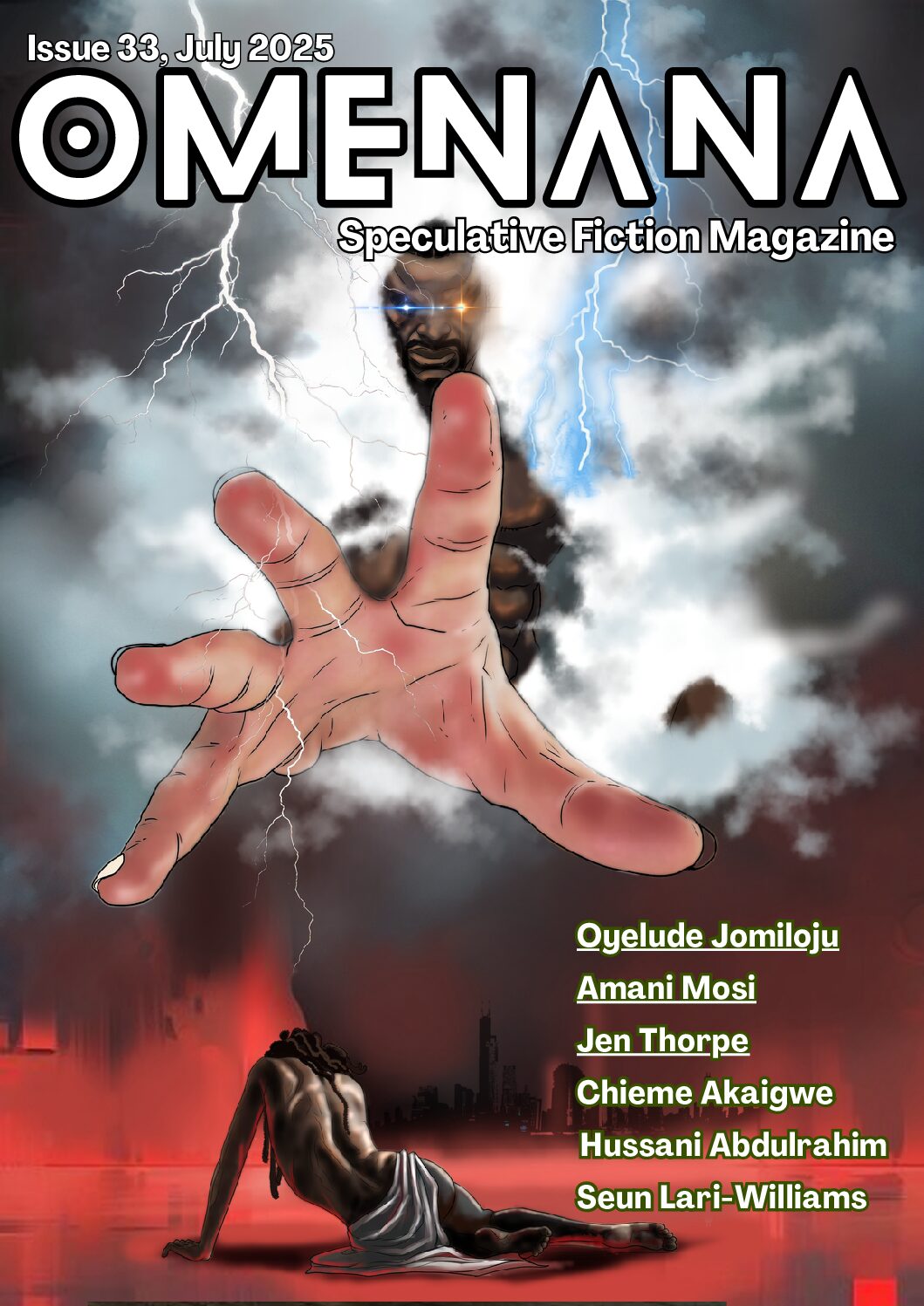
Chapter 1
¹I did not mean to summon her. I was not even sure I believed in her anymore. Or in anything for that matter. I just needed someone, or something, to hear my plea. After all, they say, “na woman wey never see problem na im dey hold breast run.”
So that day, I went to the old iroko, the last one standing in our village. I knelt in the oily mud and prayed like my grandmother used to. A prayer from grief, not faith.
² “Mama, abeg na, look our face. We don nearly die finish.”
³ I thought my prayer would vanish into the swamp air like all things do here, but that night, the sky answered. GbeneBeka returned.
⁴ My name is Wiayor, and this is the story of what happened when our goddess remembered us and what happened when we tried to, um… well, own her.
⁵ I was born around the time when our lands began to fail us. Our rivers turned thick with oil, and the mangrove swamps had become skeletons draped in black sludge. Even after the drills were silent and the company abandoned its camps, the land still bled crude. The air smelled of decay mixed with petrol. Crops withered. Fish floated belly-up in poisoned creeks. My people, once proud fishermen and farmers, coughed on the fumes of our poisoned sky.
⁶ Many had already left, scattering like frightened birds to any place that offered clean water (or just water) and untainted soil (or just soil). I stayed, because Goi was all I’d known. It was home. My home. Each day, I walked the perimeter of the village, from the remains of the old schoolhouse to the stagnant pond. I carried offerings of palm wine and kolanut to the shattered shrine of our Mother, deep in the bush. Few others bothered. Most had lost faith entirely.
⁷ And this was all thanks to “modernizing our thinking.” Critical reasoning workshops, if one could call them that, replaced storytelling hours. The chiefs held a public burning of “superstitious” objects: charms, prayer clothes, even a carved effigy of our Mother, GbeneBeka, herself. They said it was the dawn of a rational age.
⁸ I went along with it, but at night, I would sneak to the old iroko to pray. The path was always empty, as most of us had already forgotten how to hope. Worse, we had even learned to mock the gods. But I remembered the stories my grandmother, “mama”, told me. Stories of GbeneBeka, the great “Mama from the Above”, who had first led our people to these fertile lands. Mama said that in ancient times, GbeneBeka gifted us abundant harvests and watched over us, but we had since forgotten her and her ways. Some nights, by the dying fire, she would whisper, “One day, someone will cry loud enough, and our mother will hear.”
⁹ As a boy, I’d imagined a beautiful giant descending on a ladder of clouds. This image was engraved deep inside of me like symbols on carvings… Anyway, as I was saying, I prayed that night.
Chapter 2
¹As I knelt, a sudden breeze swept through the heat, cool and with the scent of rain. A smell we had almost forgotten. The breeze rippled the rotten water. I looked up, wiping my eyes. Above the tree, clouds gathered.
² A distant rumble of thunder made the ground tremble. I rose to my feet. A single drop of rain. Then another. Soon it was pouring. I laughed in surprise, spreading my arms as water washed over me, cleansing the oil from my skin. The ground under the iroko drank eagerly.
³ For the first time in years, the earth no longer smelled of poison but of wet soil and renewal. Through the curtain of rain, a light glowed. At first, I thought lightning had struck and set the great iroko ablaze, but the light was soft. I watched, mouth agape, as she appeared.
⁴ GbeneBeka. She came down with the rain, stepping lightly onto the highest branch of the iroko. She was taller than any mortal. Her skin was marked with patterns like the veins of leaves. Her eyes shone gold-white in the darkness. Her hair fell in black coils that sparkled with lightning.
⁵ She wore a single cloth of pale sky-blue, and in her hand was a staff of living wood, green with unfolding leaves. For a long moment, she stood upon the branch, gazing out at the land. Rain cascaded around her, but she remained dry.
At last, Mother looked my way.
⁶ “Na who call me?” Her voice was like a flute’s note. It spoke directly to my soul.
“Na me, Wiayor, your pikin,” I stammered.
“So, na you dey disturb me wit prayer every day?”
⁷ Lightning flashed. I feared she might strike me down, but her face held only sorrow. She stepped from the branch to the ground, and it seemed to me as though the earth welcomed her. She placed her hand on my head. The weight was lighter than I had expected.
“My pikin,” she said.
I fell to my knees.
⁸ “E don too tey wey I come dis place.”
The rain slowed. Frogs croaked, crickets chirped. GbeneBeka tilted her head toward the returning life.
Still trembling, I said, “Mama… we don loss finish. Our land don drink poison like kaikai. See as everytin don die. And nobody even remember you again sef…” I went on.
⁹ She answered by drawing me into an incredibly loving embrace.
“Calm down, Wiayor.” She said. “You do well as you remember me. You na good person. You try well-well.”
“So, you go helep us? You go save our land?”.
She looked toward the lanterns of the village.
¹⁰ “Even after wetin dem do your papa? Ah, you be my pikin true true!”
Indeed, there had been gossip that my father, always seen with a worn wooden pipe clenched between his teeth, was a troublesome activist who had dared to challenge both the chiefs and GulfCurrent Nigeria.
That he disappeared, not by gods, but men. They said he called them out — the Company, for the poison they poured into the creeks, for their lies, for how they flaunted their green promises in Europe, while here they flared gas night and day and let children drink firewater. He once told my mother that Ogoni was a test of conscience for the world. That if they could desecrate us and still be called civilized, then civilization meant nothing. He joined others who dreamed that we could speak for ourselves, choose for ourselves, govern ourselves. That dream cost him everything.
But the loudest story is that he was used; that someone, somewhere, fed him visions of change. Told him he was chosen. Maybe he was. Maybe that’s why they crushed him.
My mother died not long after. Some claimed it was because of grief; others said it was our bad water.
“I go do wetin I fit do,” GbeneBeka said. “Take my hand. Carry me go see everytin wey don spoil.”

Chapter 3
1 And so, hand in hand with a goddess, I returned to the village at midnight. She must have noticed that I took her through a rather long route. I led her down a narrow path, through groves of stunted palms and between silent clinics. Where her feet touched the ground, grass sprouted, little green blades pushing up through the oily muck. I watched in astonishment as it seemed like even my footprints filled with seedlings after we passed. At the first occupied dwelling, a house where an old couple still lived, I knocked frantically.
2 “Make una come out o!” I called excitedly. “Make una come see!”
When the door opened, the glow of a lantern fell upon the tall figure beside me. The old man inside gasped, dropping to his knees at once. His wife peered over his shoulder, then let out a cry of joy. One by one, people emerged from their homes. Some had been woken by the storm, others by the unfamiliar sounds of frogs and night birds. They gathered in the muddy village square, mouths agape at the glowing woman standing beside me. Ah, I remember the faces, faces that had known only despair now filled with wonder and hope.
3 Mothers held their children close. Fishermen bowed their heads. And wives. Wives struggled to find their husbands’ hands as they saw the powerful and irresistibly beautiful being. A few villagers began to sing old, half-remembered praise songs their grandparents had taught them about GbeneBeka, welcoming the goddess. GbeneBeka stood quietly among us. She spoke in Khana, our Ogoni tongue, so that all could understand. It was only then I realized she had spoken “rotten” English (Pidgin) to me, because my Pidgin, not my Khana, was the language I carried best.
4 “My children,” she said, “I have returned as you have called. I see the suffering of this land.”
5 She knelt and pressed her palms to the earth in the center of the square. I heard a vibration underfoot as if the ground itself responded.
6 “No more shall this land be barren”. Enter happiness. Disbelief in faces was replaced by gratitude. Some prostrated in the grass; others reached out to touch the new-grown plants to be sure that they were real. A young boy laughed in delight, stomping his bare feet on the soft ground. Laughter! When had we last heard such a sound here?
But amid the celebration, a coarse voice cut through.
“What is the meaning of this?”
7 It was Chief Baridi, stepping forward with his cane, flanked by two of his personal guards. He was an older man, his face carved by years of bullying others. It was hard to believe that once, he had been a firebrand for the people, but in the later days of oil he’d grown wealthy on the scraps tossed by the company.
The Chief’s eyes were now focused on GbeneBeka. No one had ever seen them in that manner. But within seconds, his eyes changed from reverence to calculation. Before I could answer him, one of the guards barked, “It’s witchcraft! A trick!”
8 A few villagers murmured in confusion. Chief Baridi held up a hand, forcing a smile. “No, not a trick,” he said, looking GbeneBeka up and down. Rain still drizzled, water beading on the chief’s fine embroidered shirt.
“If I recall the old stories, this would be our… benefactor. The Mother of our line.”
His tone was polite, almost reverent. GbeneBeka regarded him quietly.
9 “I am GbeneBeka,” she affirmed. “The land was crying out in pain. I have come to answer.”
“Truly, a remarkable night,” the chief said, bowing his head slightly.
“We are honoured by your presence, great one. Forgive my hesitation. These are strange times. We have grown unaccustomed to spirits walking among us.”
10 A nervous chuckle rippled from Chief Baridi’s guards. I stepped closer to GbeneBeka, suddenly protective. I didn’t like how the chief’s eyes lingered on her, as if assessing the value of a rare artifact.
“The times may be strange,” I said, keeping my voice respectful, “yet our need is real. GbeneBeka has already shown proof of her grace.” I gestured at the grass and blossoms underfoot.
“Our land can be healed.”
“Yes,” a farmwoman in the crowd shouted, “I can smell life in the soil again!”
Chief Baridi nodded slowly. “Indeed. A blessing beyond measure.”
He tapped his cane on the new grass, as if to assure himself it wasn’t illusion.
“We must give thanks in the proper way.” Turning to GbeneBeka, he offered a smile that didn’t reach his eyes.
11 “Great Mother, allow us to host you well well, to express our gratitude. We should have a feast to honour your return.”
Murmurs of agreement rose. It sounded like a good idea. But something troubled me. I remembered how the chief had hosted similarly grand feasts whenever a company executive visited, occasions that always ended with deals cut behind closed doors. I glanced at GbeneBeka. She was studying Baridi, perhaps reading his face.
“I come not for feasts, but to heal,” she said gently. “There is much work to be done for this land to be whole again.”
“Of course, of course,” the chief hurried to reply. “Yet your children wish to honour you. Please, will you not rest and dine with us tomorrow? We have a community hall still standing; we can gather there at dusk. You may speak to us of what must be done, and we’ll slaughter dogs in your name.”
GbeneBeka flinched. I doubt anyone else noticed, but I did. I lightly touched her arm, with the hope that she’d understand that to mean that they had forgotten her taboos. A lot of the villagers did not trust Baridi, but I knew they were excited and would follow their leader’s suggestion. Perhaps it would be alright, a feast could be harmless, a chance to cement her welcome. After all, what could the chief possibly do to a goddess? GbeneBeka inclined her head.
“If it pleases the community, I will come at dusk tomorrow to your gathering,” she said at last. A cheer went up. The chief flashed a grin that looked political. That night, we settled GbeneBeka in the finest hut we had. My late uncle’s place, which was roomier than most. Many villagers brought mats, clean cloth, food. GbeneBeka accepted only a simple wrap to change into (her sky-blue cloth, though miraculously clean despite the mud, made her too conspicuous, she said with a soft laugh).
She sipped politely at the palm wine offered. Until the sky paled with dawn, I stayed near her, answering her gentle questions about all that had befallen our land in her absence. I told her of the oil boom that came, how at first we rejoiced, thinking fortune had finally smiled on us. I described the pipelines that snaked through our fields, the gas flares that turned our nights into false daylight, the spills that poisoned our water. She listened with deep sorrow, nodding or sighing as if hearing of wayward children. But I know now that she already knew. I didn’t need to recount the protests and the violence. She knew more than me.
Dawn arrived gentle and clear. All day, GbeneBeka moved through the village and beyond, bringing small miracles wherever she went. A bedridden elder, Baba Madara, rose from his mat, breathing easy. Barren cassava fields sprouted green shoots at her touch. Word spread quickly, and by midday people from near and far had gathered to see the wonder with their own eyes. I stayed by her side, shoulders swelling with pride and hope. Me, ordinary me. My prayer had been answered beyond my dreams; it seemed a new dawn for our land. Yet as the crowds grew, I felt a knot of unease. Many folks came with pure gratitude, but others thrust forward with selfish pleas, begging GbeneBeka to cure every ill, to bless their ventures, to make them rich.
She gently reminded all that she came to heal the land and not to conjure gold or grant favours. Some understood and bowed thankfully. But I caught many frowns, from those dissatisfied that her gifts would not fill their pockets overnight. Then I spotted Chief Baridi at the edge of the crowd, fussing over some newcomers in crisp shirts who had arrived in shiny cars.
Even from afar, I recognized them. My shoulders sank. Company men. Or maybe Government men. Though their rigs had left, some still prowled for opportunities in our region. And here they were, drawn by the scent of miracles. Among them I saw Mr. Cole, the foreign manager who was known as the “condolences manager”. The chief was gesturing excitedly, talking to them with a suspicious grin, and they kept glancing toward GbeneBeka as if measuring her worth. It made me very angry. This was a sacred blessing for our people. What right had those profiteers to be here at all?
As evening fell, nearly two hundred people crowded around and inside our community hall for the feast. Chief Baridi ushered GbeneBeka to a seat of honour at the head table, a wooden chair draped in our finest cloth. The hall was aglow with torchlights and buzzing with anticipation. Tables overflowed with food provided by the company: roasted meat, yams, plantains…
GbeneBeka had to duck under the low doorway, and when she entered, the assembly fell quiet, with every eye upon her glowing form. The people had already begun eating before GbeneBeka spoke.
“My children,” she said. Suddenly, they remembered who was before them again. “Today I have seen your pain and your hope. I have come to heal this land, but I cannot do it alone. I will need your help. Your patience, your faith, and your understanding that what I offer is life and renewal, not gold or weapons or power over others. Use the gifts I bring with wisdom and humility.”
There was a murmur of agreement. People came forward with laughter and songs, pressing food and palm wine on one another. She barely tasted the offerings, but smiled kindly, accepting the spirit in which they were given. A drum and flute struck up a joyful tune, and for a short while I was pleased to see my people united in hope.
Chapter 4
Just before the speeches began, I went to wash my hands after the food, then I caught two company men whispering behind a parked car, their backs turned. One carried a bundle of something wrapped in cloth.
“I still can’t believe the plan worked,” one said, laughing loudly. “How they found just the right vessel. The pious believer.”
The other replied, “The chiefs dem don talk sey Wiayor still dey pray. Sey im holy die!”
I halted. Their words weakened my knees.
I pressed myself against the wall. But each word sank deep. Had they watched me all this time? Maybe they even fed the ember of belief they now mocked. Ahh! Was my faith, my grief, all part of some twisted script?
I backed away. I had to tell GbeneBeka.
But as I stepped into the hall, I froze again. Custom sealed my lips; You don’t interrupt elders, especially not when the goddess you called down is being courted like some market bride. I opened my mouth, but nothing came. I stood there, caught between urgency and the reverence that had been conditioned into me. And in that pause, Cole began to speak.
“Pardon me, Great Mother,” Cole, the condolences manager, said smoothly, switching to English.
“What an absolute privilege to witness this… uh, environmental miracle. I represent certain parties interested in the well-being of this region, and I believe we could help share your gifts with the world. Imagine if we collaborated. Your powers could bring prosperity everywhere! There would be great benefits for Ogoni people, of course.”
I winced. My father had taught me better; Ogoni was enough. The land and the people were one — you did not split them with bureaucratic terms. To do so was to speak like an outsider, even when you meant well.
Before GbeneBeka could respond, Chief Baridi eagerly added in our language, “Yes, Mama! With your help, our land can be rich again. The oil may be gone, but perhaps there are other blessings you could bestow: water, fertile soil, new resources… We would ensure it is managed properly. Our people deserve compensation after all these years, do they not?”
His smile was thin, his eyes switching between the goddess and Cole. A heavy silence fell. GbeneBeka slowly rose from her seat. When she spoke, her tone was rather cold.
“I did not return to make any person rich,” she said. “And I will not help anyone exploit this land further. What remains in the earth must stay in the earth if the land is to heal. I came to give life, not wealth. If you seek only profit, I will leave this place.”
The chief’s eyes reddened at being chastised before everyone. Cole’s polite mask slipped, revealing a scowl.
Then suddenly, Cole spoke louder than we’d ever heard him speak.
“There are ways to harness energy like yours,” he said. “Clean, renewable, bio-spiritual resources. The technology is evolving. With the right containment protocols, your gifts could be channelled safely. We could bottle your blessings, so to speak.”
Chief Baridi burst out laughing.
“Yes, Mama de Mama. We would treat it with respect, of course. But it will be our own miracle supply. Rain on demand, soil that never fails, healing water. Your presence could make our land brand new.”
For a second, all was quiet, but many faces were flabbergasted. GbeneBeka tilted her head slowly. Her face revealed nothing.
Chapter 5
Then suddenly there was a blinding flash and an ear-splitting bang as a grenade detonated in the center of the hall. I flung my arm over my face, staggering as chaos erupted. Villagers screamed and stumbled in panic. Taking advantage of the confusion, the company’s henchmen and the chief’s guards rushed forward. They hurled a thick net studded with either charms or some technology over GbeneBeka, entangling her.
“Aha! Hold am well well!” an old chief shouted.
“GbeneBeka Holdings,” Cole mocked.
She cried out in pain and surprise as the net sapped her strength, its cords tightening around her like the coils of a snake.
“No!” I shouted.
Through smoke and the madness, I saw the men struggling to hold the net. Without thinking, I reached for the small pocketknife I always carried at my waist — a keepsake from my father — and hacked at the net with all my might. It hurt my palms, but I ignored the pain. A guard charged at me. I kicked him away as I looked around to see if anyone else would volunteer some help.
I picked up a stone and flung it. Cole’s skull gave way like an overripe melon: sweet, sudden, and deserved. He staggered back with his hands reaching for nothing. He collapsed, blood blooming at the base of his skull.
“Wiayor!” GbeneBeka gasped, pinned to the floor as they pressed her down. Then, just as the pocketknife tore one of the cords, GbeneBeka screamed. Every light in the hall died at once. The ground shook and the hall split apart. People and tables tumbled as a gaping hole opened beneath us. I felt myself falling amid splintered planks and screams. Water, cold and fierce, rushed up from the depths of the earth.
In the blink of an eye, a flood of dark water burst through the gap, sweeping across the collapsing hall. I was caught in its current and pulled under, tumbling in darkness. I felt GbeneBeka’s arm clamp around me, holding me tight as the flood swallowed us.
Moments later, my head came out to the surface. Coughing, I found myself being carried swiftly downstream by the swollen river. Night had fully fallen. GbeneBeka was beside me in the rushing water. Her eyes were glowing in the dark. The current bore us away from the village with relentless speed. We managed to drag ourselves onto the far riverbank, hidden by reeds. I collapsed to my knees on the wet earth, chest heaving. Across the water, faint shouts and flashlight beams showed our pursuers scouring the opposite shore, but they had lost our trail. We were safe, but it didn’t feel like safety.
As I knelt there, I felt terrible about what had happened.
“I’m sorry,” I blurted out after catching my first breath. “Great Mother, I am so sorry. I brought you into this… and they… they tried to…” My Khana failed under the weight of guilt and sorrow.
GbeneBeka placed a hand on my shoulder. Warmth flowed from her palm into me, steadying my breaths.
“No be your fault, Wiayor,” she said softly. “You na better person. Lion no dey born goat. Dis betrayal na for their head.”
I looked up. In the moonlight, she looked hurt, but her resolve seemed unbroken.
“This has happened before,” she murmured. “Greed! Ah….and dem warn me o! Di elders been warn me. But I tink sey…”
She did not finish the thought.
Chapter 6
1 Then for the first time, I saw unmistakable anger on her face.
2 “Na me dem wan take use do fuel,” she said. “Me? Ahh, I don suffer.”
3 She stood slowly, facing the direction of the village, now hidden behind the trees. Before I could speak, she raised her arms to the sky and said:
“Pikin wey say im mama no go sleep, im sef no go sleep.”
4 There was a strange stillness. The night suddenly turned to day, like a switch. But there was no sun. The earth beneath us rumbled. Across the river, we watched as the village shone. The soil cracked, and black water swelled. Roots and tree branches twisted. Then came the cries. Shouts. Buildings buckled. Flood met flames from hell. The earth swallowed all that had scorned her, and who stood by in silence.
5 But GbeneBeka, she began to dim.
Her hair lost its light. The mantle of clouds above her dispersed. Her eyes, once gold-white, became brown, then smaller, then simply… human.
I rushed to her side.
6 “Wetin happen, Mama? Wetin dey do you?”
“I gave all,” she said. “The land is awake now. It is clean.”
7 I caught her before she collapsed. She felt… lighter and looked different. Her skin was warm, her breathing shallow.
Chapter 7
1 That was the end of her divinity. But the beginning of us. We found a clearing where birds sang. We built a shelter with our hands.
2 The rains came, we welcomed them. She planted seeds. I fished in a stream that ran clear.
3 Some nights, she weeps. Some nights, we laugh.
4 And some days, we walk the land together, collecting shells. Two keepers of a soil still healing.
5 We have no name for this place. Perhaps one day they’ll call it Eden.
6 But we call it home.